

For years, we talked about technical debt as something that quietly piles up while teams ship fast and skip cleanup. You take a shortcut now, but you pay for it later, usually at the worst possible time. A newer version of that problem is showing up in software delivery, driven by AI coding agents and AI discovering security vulnerabilities. Nobody actually trusts the code once it ships. We seem to have chosen fast and lost good along the way; call it quality debt.
Most companies no longer struggle to ship software; AI coding assistants handle that part. Code changes go out weekly, sometimes daily. A few years ago, monthly would have been considered aggressive in many enterprise organizations. Testing struggles to keep up. QA teams are still largely running on Agile or DevOps rhythms designed for a slower world, and the gap between how fast code moves and how quickly anyone can verify it works is widening, not narrowing. That’s quality debt. You can ship something through a CI/CD pipeline in an afternoon and still have no real confidence the new code is better than yesterday’s version.
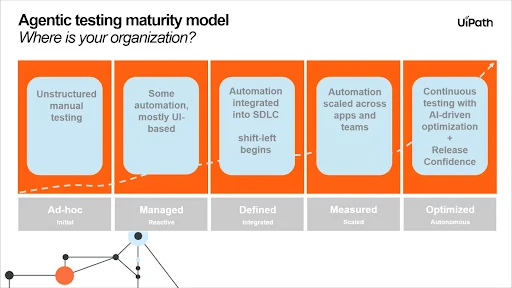
UiPath’s answer to this is Test Cloud, which Josh Duke demonstrated in the Tech Field Day Showcase. I like the maturity model they used to frame the whole problem; it helps identify where organizations actually sit in terms of testing maturity. At the bottom you’ve got manual testing, people clicking through screens and hoping they remember what to check. Above that, scripted UI automation drives a virtual keyboard and mouse, usually thin on API and mobile coverage, the kind of automation that cannot cover much and breaks often. The third layer is automation that’s genuinely built into the software development lifecycle (SDLC), where testing shifts left instead of happening at the end. At the top is continuous testing, with AI adjusting things in real time. UiPath argues that most organizations are still stuck in the first two stages, with slow, fragile testing, while those same companies’ development speed has already jumped ahead to the last stage of full AI productivity.
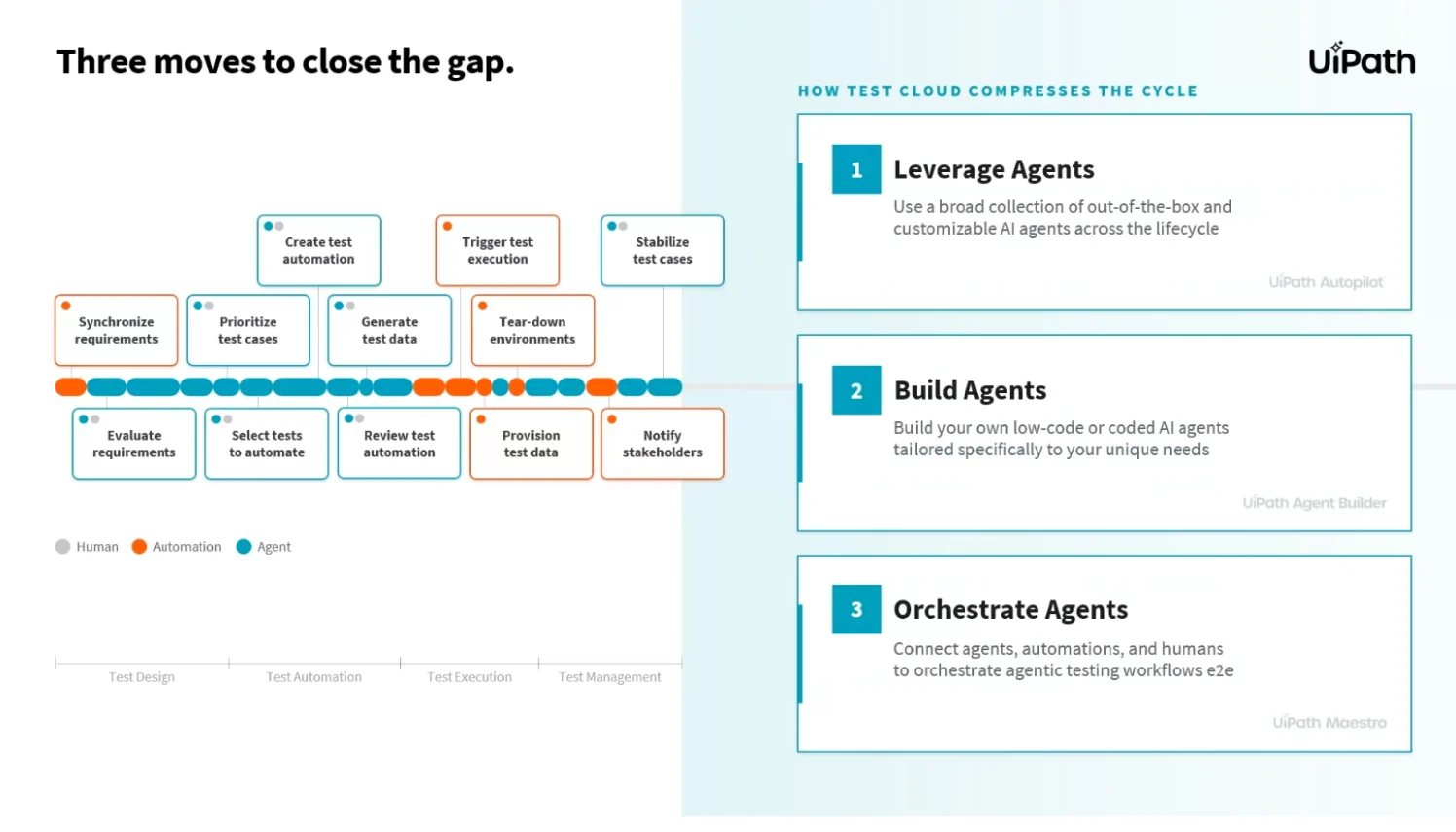
UiPath’s demo didn’t try to collapse the whole problem into one kind of automation. They draw a clear line between robots and agents, and they keep both. A robot runs a test case exactly the same way every time, following predefined steps, with no reasoning involved. That’s the right tool for stable, repeatable regression testing, the boring stuff that should behave exactly the same on run 500 as it did on run one. An agent is different because it uses AI to reason through each step and can adapt if something in the workflow shifts. That’s better suited to first-pass testing, or anything ambiguous enough that a fixed script would break the moment the app changed underneath it. One of the delegates at the showcase asked UiPath why customers would spend tokens on agentic reasoning for something that should run the same way every time. UiPath’s answer was simple: you shouldn’t. Use the robot when the task is stable and use the agent when it isn’t. Nobody’s pretending agents should replace deterministic automation across the board; AI is an augmentation, not a replacement.
The part of the demo that best showed this used a fictional banking app called UiBank. You pull in a requirement, click the “optimize coverage” button. An AI model reads the requirement and any attached screenshots or documentation, then returns gaps the test author probably missed. Maybe an unspecified email format, maybe a missing character limit. A human still reviews every suggestion before adding anything, and if you’ve configured the right integration, approved changes can sync back to Jira or Azure DevOps. Generating the actual test cases follows the same pattern: provide context and review what comes back. It’s a faster first draft with a human still making the calls. Even better, the agentic test can be converted into a robotic test, so repeated testing runs faster and doesn’t consume tokens.
There’s also a built-in Healing Agent that handles the kind of runtime breakage that normally eats a QA engineer’s morning. A new code version might introduce selector changes, blocking overlays, load timing issues, the sort of thing that requires a script update before the test will run. When the Healing Agent reasons through a failure and can fix something, it does. When it can’t, it surfaces the issue for a person rather than failing or blocking the entire run. The agent and orchestration story is huge, but the healing agent probably saves the most actual hours.
The most ambitious pieces are Agent Builder and Maestro, which let you build a specialized agent conversationally and then orchestrate robots, agents, and human checkpoints into a single end-to-end workflow. You can insert a human at any point before the process continues. UiPath is fairly open about where this is heading: a largely autonomous SDLC testing cycle, with people checking in at key moments rather than running every step by hand. Jay Cuthrell asked how a team without an established quality operating model would actually learn to design one of these combined workflows without just guessing their way through it. The answer was professional services, certified partners, and training, which tells you this is still early.
None of these tools closes the quality debt gap by itself. What it does is give teams a real set of tools to start closing it deliberately: robots for the stable work, agents for the parts that need judgment, and a maturity model that at least tells you where you’re standing before you decide where to go next.
You can watch the full UiPath Tech Field Day Showcase, including the Test Manager, Test Studio, Agent Builder, and Maestro sessions, on the appearance page at TechFieldDay.com.