
Google’s Docsy is joining the Linux Foundation as AI agents become documentation readers.
Prague — When I grew up in programming, if you didn’t understand something in the code or operating system, you were told to Read The Fine (Ah, yeah, fine) Manual (RTFM). Of course, back then we actually had manuals and documentation. Since then, good documentation has fallen by the wayside. As Jon Corbet, editor of LWN, the best deep-dive Linux publication and overseer of Linux kernel documentation, has said, “There is not a single person whose job it is to write documentation for the kernel.” In 2026 at Linux Plumbers, Corbet said that’s still true today.
These days, however, it’s not just disgruntled system administrators and programmers who want good, up-to-date documentation; AI agents want reliable docs as well. No one ever wanted to pay for humans to have good reference materials, but with AI agents, it’s a different story. Without good information, AI is prone to Garbage-In, Garbage-Out (GIGO). That’s where Docsy, the open-source documentation theme created by Google’s technical writers, comes in.
At Open Source Summit Europe, Google announced that Docsy has moved its home base to the Linux Foundation. It also–surprise!–has expanded support for AI agents.
The move connects Docsy more closely with an ecosystem that already uses it. Erin McKean, a Google Senior Developer Relations Engineer and a member of the project’s steering committee, said Linux Foundation projects ranging from sandbox-stage efforts to Kubernetes already rely on Docsy.
McKean’s argument for the project starts with a more familiar open-source problem: documentation takes work, and maintainers need help producing it. She said better documentation can reduce the burden of answering questions that users could otherwise resolve themselves.
Docsy’s developers are adapting documentation publishing to serve two audiences: people reading websites and AI tools retrieving instructions to answer questions or write code. As McKean said in her keynote, “You can add Markdown right alongside your documentation for tools that prefer that format.”
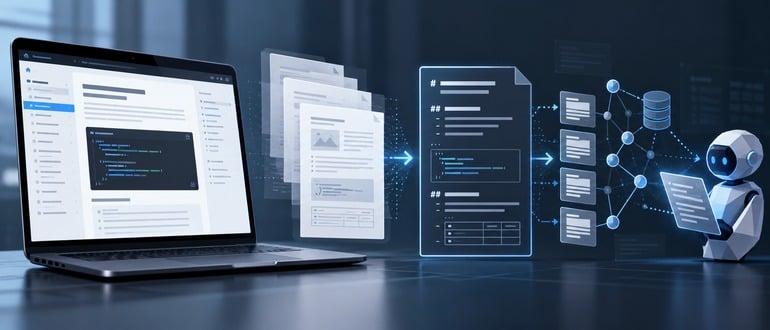
Docsy introduced its first phase of agent support in version 0.15.0. The experimental, opt-in features generate an llms.txt documentation index, Markdown alternatives for home pages, sections, and individual pages, and a “View Markdown” link.
Why is this important? It’s because people and AI read documentation differently. A documentation website’s HTML serves you and me with navigation, layout, and presentation. A Markdown alternative exposes the underlying explanations, headings, links, and code examples in a simpler text-oriented format, suitable for AI.
As Anthropic has explained, modern AI needs documentation like this for better context engineering. This is the strategy for “curating and maintaining the optimal set of tokens (information) during LLM inference, including all the other information that may land there outside of the prompts.”
In practice, with Docsy documentation, an agent can consult an index, select pages relevant to its task, and fetch their Markdown versions. Those documents then become context for the language model. The agent can use this information to construct an answer or choose its next action. Anthropic describes this approach as just-in-time retrieval, where an agent dynamically loads information rather than putting everything into its context.
Docsy’s release documentation describes the features as helping agents “discover and use your site content,” rather than promising a particular model outcome.
For an AI coding assistant, that could mean retrieving an API’s authentication instructions and endpoint documentation before composing a request. It’s a way to consult published documentation during a task, not a mechanism for retraining the model.
Docsy itself is quite simple. It’s a theme for the Hugo static site generator. It supplies navigation, site structure, and other components for technical documentation websites. Its code is available under the Apache License 2.0.
For McKean, the underlying goal remains helping people use software, even when an AI assistant stands between the reader and the documentation. “But when we’re making technical documentation, it really doesn’t matter how the information becomes useful to humans, as long as it does,” she said. “If someone told me that there was evidence that said, you know, opera is the best way to reach your project users, I’d be writing operas.”