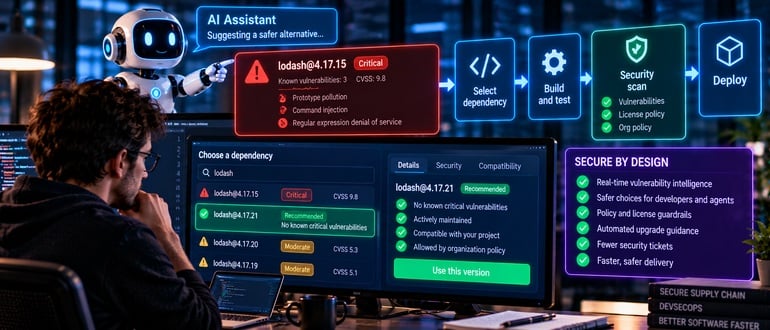

For years, the software industry’s answer to vulnerability overload has been straightforward: Find issues earlier, prioritize them better and fix them faster.
That strategy is working. Automated dependency updates, policy-driven workflows and CI/CD integrations have accelerated remediation. Recent longitudinal data shows the median age of unresolved Critical and High vulnerabilities fell 59% from its January 2024 peak, while more than half of resolved violations are now addressed within a single day. Yet applications continue accumulating risk as software production and vulnerability discovery accelerate. Addressing that imbalance requires teams to look further upstream at how software decisions are made in the first place.
AI is Accelerating Dependency Decisions
Developers have always made trade-offs when selecting dependencies, weighing functionality, compatibility, maintenance, security and organizational requirements. What’s changing is the speed and volume of those decisions as AI coding assistants and agents take on more development work.
Coding agents can compress hundreds of component decisions into a much shorter development cycle. That creates a significant productivity opportunity while putting pressure on security controls that evaluate those choices only after they’ve been made.
Consider what happens when a developer or coding agent selects a vulnerable dependency. A downstream scan identifies it, an alert or ticket lands in the backlog, someone evaluates the issue and the developer is eventually asked to revisit the dependency. By then, the feature may be finished and the developer may have moved on to something else. An earlier decision has now become rework.
Some of that rework is avoidable. In many cases, lower-risk versions of vulnerable components are already available when a dependency is selected. The challenge is giving developers and AI agents enough current context to understand which choice carries less risk at the moment they’re making it.
Make the Safer Choice the Easier Choice
Faster remediation will always be essential. New vulnerabilities will continue to emerge in software that was considered secure when it was built, so organizations will always need to identify and fix problems downstream.
Teams can reduce some of that work by bringing security context closer to the original decision. If a dependency has a critical vulnerability, violates policy or has a materially safer alternative, developers and agents should have that information when they’re selecting it.
Earlier context means fewer tickets pulling developers back into completed work and fewer avoidable findings entering security queues. As agents take on more development work, those same signals and guardrails need to be available to them as they make component decisions.
The goal should be to make good security decisions part of the development workflow without adding another layer of manual review. Developers shouldn’t have to research the constantly changing risk profile of every component, and agents need access to the information required to make informed choices.
What Developer Teams Should Do Differently
Moving security earlier should make developers’ jobs easier while allowing security expertise to inform decisions without adding unnecessary friction. Four changes can help:
Bring security intelligence to the point of selection. Surface current information about vulnerabilities, component health and organizational policy while developers and agents are choosing dependencies. Giving them that context upfront can reduce issues that would otherwise surface later in development.
Give agents the same guardrails as developers. Organizational policies around approved components, risk and licensing should inform the software decisions agents make, just as they inform human development. As agents gain greater autonomy, those guardrails need to travel with them.
Automate the path to a safe upgrade. Identifying an outdated or vulnerable dependency is only the beginning. Automate routine version selection, compatibility checks and testing where possible so developers receive a validated path forward rather than another alert to investigate.
Measure what enters the pipeline. Teams already track how quickly vulnerabilities are addressed. They should also measure how frequently avoidable risk is introduced in the first place. If fixes are getting faster while the backlog keeps growing, the development process itself deserves a closer look.
None of these changes require slowing development. In fact, reducing downstream security rework becomes increasingly valuable as AI helps teams ship more software faster. The more decisions that can be made the first time correctly, the fewer interruptions developers face later.
Reduce the Rework
Prevention and remediation increasingly need to work together. Every avoidable vulnerability that enters an application creates downstream work, from triage and ticketing to fixing, testing and deployment. Preventing some of that work gives developers more time to build and security teams more capacity for the risks they can’t avoid.
AI will continue accelerating software development and increasing the number of decisions made along the way. Security practices need to keep pace with that development model. After years of optimizing how quickly vulnerabilities can be fixed, teams now have an opportunity to improve the decisions that determine which risks enter software in the first place.