
Game testing has always been an unpredictability problem for developers. Players move in the wrong direction, trigger events out of order, or combine mechanics no designer anticipated. Even so, developers could usually define the rules governing the world and check whether the game followed them.
AI is making that harder. NPCs now react to changing conditions, and animation systems select behaviors based on surroundings rather than a fixed sequence. Take-Two Interactive, Rockstar Games’ parent company, holds a patent for a virtual character locomotion system that uses modular animation building blocks and selection criteria to control how characters move through a 3D environment, one sign of character behavior becoming more responsive to context instead of scripted.
That can make for a more convincing game, but it leaves developers wondering: How do you test software when you can’t list every way it might behave?
The Test Matrix is Getting Harder to Define
Games already have a larger testing surface than most applications, including a physics engine, real-time movement, character states, inventory systems, dialogue trees, and multiple paths through the same scene. Each of these combinations multiplies the number of states to test.
Consider an NPC encountering a player. In a scripted system, entering a certain area causes the NPC to walk to a fixed spot and start a line of dialogue, a known input with an expected result. Now let the NPC’s response depend on the player’s location, earlier interactions, nearby objects, or what another character is doing. Several responses may all be valid, and there’s no longer a single sequence to verify. Multiply that across hundreds of characters and a large player base, and exhaustive testing stops being realistic.
Scripted testing still matters for known functionality, regression testing, and core mechanics; it just can’t catch a failure that comes from a combination nobody thought to write into the test plan.
Manual QA Can’t Try Every Combination
Human testers are good at judgments that resist a pass/fail test, including whether movement feels wrong, a mechanic is poorly balanced, or an interaction technically works but makes the game less fun. What they can’t do is exhaust every combination of actions and states, and that limit was already showing before AI entered the picture. LiveOps games, like Roblox, Grand Theft Auto Online, and Skate, ship frequent updates and seasonal content, which means repeated regression testing across devices, operating systems, and hardware configurations. This is a burden that grows with every release.
AI-driven gameplay adds behavior on top of that matrix. A QA team can run the same quest dozens of times without issue under numerous circumstances, like a player who carries a different item or approaches from another direction. However, all it takes is one tiny circumstance, such as picking a rarely used dialogue option, to expose a bug immediately. The team didn’t miss an obvious test. The combination simply never came up.
The industry’s response has been to lean harder on automation rather than headcount. By 2026, about 47% of gaming studios reported using AI for QA and playtesting, and those studios say it has cut testing costs by 30% to 40%. Square Enix has said publicly it wants 70% of its QA pipeline automated by 2027. The drive for AI-driven QA processes is generating new ways, to quickly and securely test code, like deploying synthetic players.
Synthetic Players Can Cover More Ground
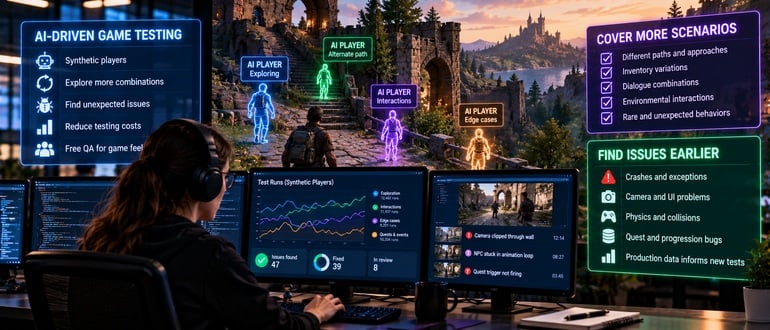
Instead of following the same fixed path on every run, automated players can move through a game, interact with mechanics, and try different combinations of actions continuously. When my team was at GDC 2025, we witnessed AI-driven synthetic-player systems navigating game worlds: jumping, colliding with objects, moving through menus, and interacting with mechanics.
And speed isn’t the only value of this. These players can spend time on interactions a human tester would rarely repeat, like trying every path through a quest, carrying different inventory combinations, approaching a character from several angles, and running it all again. A synthetic player might find errors like a camera angle that hides an important UI element, or the one combination of inventory and dialogue choices that causes a crash after hours of trying.
None of that removes the need for human testers. Instead, it changes where their time goes. Machines take the repetitive exploration while developers spend more time on game feel, balance, pacing, and whether an interaction makes sense from the player’s perspective.
Production Tells You What the Test Suite Missed
Even an extensive pre-release test suite won’t reproduce every combination that real players eventually create, which makes production data useful for more than incident response. The traditional loop is reactive: crash, report, investigation, and fix. But a recurring production failure also tells developers what to test in the next build.
Roblox is a useful example of how this looks at scale. As its community grew past 10 million players, the team had to work through millions of crash reports across Windows, Linux, Mac, mobile, and consoles, and needed to identify the crashes hurting players most without drowning developers in an undifferentiated stream of reports.
Using advanced error reporting capabilities, Roblox aggregated incoming crashes and exceptions, grouped related errors, and used crash classifications and other diagnostic information to narrow down root causes. Roblox senior engineer Christopher Swiedler said the system cut the time needed to generate crash reports while improving their accuracy, and the case study also reports a 50% increase in monthly active users after implementation.
AI-Driven Games are an Early Test of a Broader Software Problem
Gaming makes this challenge especially visible because variation is the goal. Players are supposed to explore, and characters are supposed to react. But the problem isn’t unique to games. Developers are integrating AI into applications that make decisions, respond to context, and can produce more than one acceptable result.
Conventional regression tests still matter, and so does manual testing. But teams will also need to explore combinations they didn’t explicitly script, define the limits of acceptable behavior, and keep enough information to reproduce unusual failures when they occur. Developers are never going to test every move a player can make or every action an AI-driven character can take, and now, with the help of AI tools like synthetic players and advanced error reporting, they don’t need to.