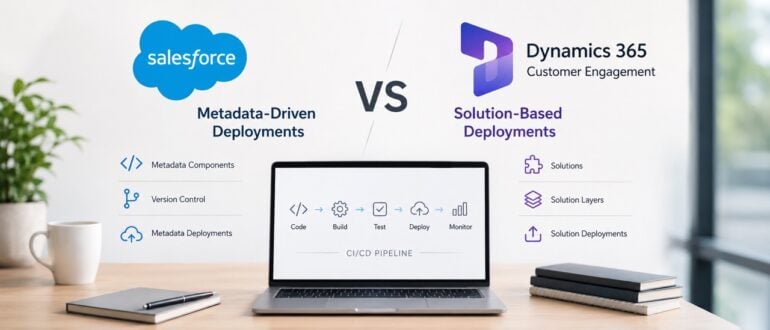

Most organizations running CRM platforms eventually face the same challenge: how to deploy changes safely, consistently, and quickly. While Salesforce and Dynamics 365 Customer Engagement (CE) support modern DevOps practices, they approach application lifecycle management differently. Understanding these differences can help teams design more effective deployment pipelines and avoid common release issues. As these platforms become increasingly critical to business operations, the need for effective DevOps practices has grown significantly.
Unlike traditional software applications, CRM platforms combine configuration, metadata, security models, workflows, integrations, and custom code into a single ecosystem. A deployment rarely consists of code alone. It often includes business processes, user interface changes, security updates, automation rules, and integration modifications. This creates a unique challenge for DevOps teams. A seemingly small change can affect multiple business functions across departments. A modified field may impact reports, workflows, integrations, security permissions, and user experience simultaneously.
As organizations expand their CRM footprint, managing these interconnected components becomes increasingly difficult. This is where mature DevOps processes become essential.
Salesforce: Metadata-Driven Deployments
Salesforce is one of the most widely adopted cloud platforms for customer relationship management and business process automation. As organizations build increasingly complex applications on the platform, DevOps practices have become essential for managing changes efficiently and maintaining system stability.
Salesforce development revolves around metadata. Nearly every customization within the platform can be versioned, tracked, and deployed as metadata.
Business logic is distributed across numerous components including Apex classes, Lightning Web Components, Flows, Validation Rules, Permission Sets, Custom Objects, and Profiles. These components collectively form the application landscape. This architecture provides significant flexibility but also introduces complexity. Dependencies are often spread across multiple metadata components, making it difficult to fully understand the impact of a change before deployment. For example, a modification to a custom field may affect Apex code, automation flows, reports, validation rules, integrations, and user interfaces. While deployment tools can identify technical dependencies, they cannot always predict business impact.
As Salesforce environments grow, managing metadata relationships becomes one of the primary responsibilities of DevOps teams.
Dynamics 365 CE: Solution-Based Deployments
Dynamics 365 Customer Engagement (CE) is a cloud-based business application platform that helps organizations manage sales, customer service, field operations, and customer interactions. As businesses increasingly customize and integrate the platform with other enterprise systems, DevOps practices play a critical role in ensuring reliable deployments and maintaining application stability.
Dynamics 365 Customer Engagement follows a different model. Instead of deploying individual metadata components, organizations typically package changes into Solutions.
A Solution acts as a container that groups related customizations including tables, forms, views, plugins, business rules, security components, model-driven applications, and Power Automate integrations. This packaging model provides a structured deployment mechanism that many enterprise teams appreciate. Rather than moving hundreds of individual components, teams can transport business functionality through managed solutions. However, Solutions introduce their own challenges. Solution layering, dependency management, and managed versus unmanaged customization strategies require careful governance.
In large organizations, troubleshooting deployment issues often involves understanding how multiple solution layers interact with each other. While this approach offers strong packaging capabilities, it can also create complexity when multiple teams contribute to the same environment.
Source Control and CI/CD
Source control and CI/CD form the foundation of modern DevOps practices. By maintaining a single source of truth for application changes and automating deployment processes, teams can improve release consistency, reduce manual errors, and accelerate software delivery.
Both platforms support Git-based development and automated deployment pipelines. Salesforce generally provides greater visibility into individual component changes because metadata can be tracked independently. Dynamics 365 CE focuses more on solution packaging, which can make source control management slightly less granular. From a CI/CD perspective, both platforms integrate well with GitHub and Azure DevOps. The biggest difference is not tooling but deployment philosophy: Salesforce moves metadata, while Dynamics moves solutions.
Testing and Release Quality
Testing remains a critical component of any DevOps strategy. Salesforce requires Apex tests to be executed before deploying custom code to production, creating a built-in validation mechanism that helps reduce release risk. Dynamics 365 CE provides greater flexibility, allowing organizations to define their own testing and validation processes. Regardless of platform, automated testing and release validation help improve deployment confidence and reduce production issues.
Conclusion
After working with both platforms, one lesson becomes clear: most deployment failures are not caused by the platform itself.
Problems usually stem from inconsistent development practices, insufficient testing, poor source control discipline, or unmanaged environment changes. Teams that establish strong DevOps fundamentals—version control, automated deployments, testing standards, and clear governance—tend to achieve successful outcomes regardless of the CRM platform they use.
For practitioners, the most important factor is not choosing the “better” platform. Each platform presents unique challenges, but both can support reliable and scalable enterprise delivery processes when backed by strong DevOps practices. Success depends on implementing consistent DevOps practices that reduce risk, improve release quality, and support long-term scalability.