The newly appointed CEO of CloudBees, Mo Plassnig, says that as the agentic artificial intelligence (AI) era dawns, the time has come to reinvent software engineering in a way that moves beyond human-centric tooling.
Plassnig, who earlier this month succeeded Anuj Kapur, joins CloudBees from Immuta, a provider of a data security and governance platform, where he served as chief product officer. However, Plassnig was also one of the founders of Codeship, a provider of a hosted continuous integration and continuous delivery (CI/CD) platform that CloudBees acquired in 2018.
As the way applications are built and deployed fundamentally changes, DevOps workflows will need to evolve to accommodate massive amounts of code that is being generated by both professional developers and, increasingly, so-called citizen developers, said Plassnig. In fact, writing code is no longer a constraint, he added. Before too long, end users will routinely express an intent that will be converted into a set of prompts that generate not just code but also a pull request, noted Plassnig.
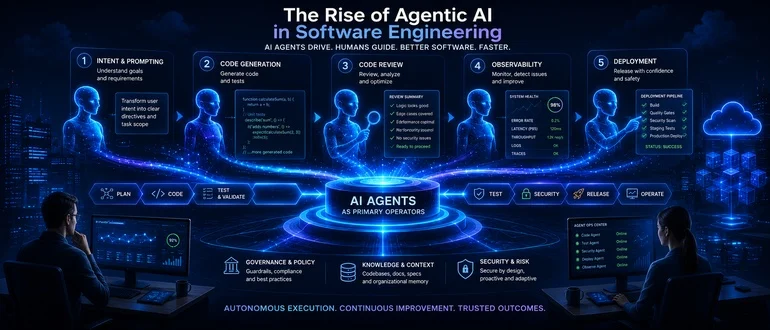
Software engineering teams, as a result, will need to focus on how to define agentic engineering workflows that rely more on AI agents to review, observe and deploy code generated using AI coding tools. Current workflows are still far too dependent on, for example, software engineers to review code that is being created at a pace that is already overwhelming existing human-centric workflows, noted Plassnig.
It will not be feasible, however, to reinvent software engineering workflows overnight. Instead, over time software engineering teams will be able to transition to agentic engineering workflows as existing tools, platforms and processes are re-engineered, said Plassnig.
The challenge will be determining what mix of tools to adopt first based on how rapidly they evolve and existing commitments to CI/CD platforms such as Jenkins. Existing CI/CD investments will continue to remain relevant but increasingly the primary end user of those platforms will be AI agents, he added. Humans, instead, will assume more responsibility for overseeing the management of tasks performed by those AI agents as they mix and match AI models based on total cost and performance requirements, noted Plassnig.
In fact, the overall level of stress for software engineering teams might not even decline in the age of AI, he added. Instead, as application development and deployment scale using AI agents, software engineering teams are likely to encounter different types of stress, noted Plassnig.
CloudBees has not ruled out any potential acquisitions to accelerate its overall strategy, with the focus being on providing a mix of organic innovations and, if necessary, acquisitions, added Plassnig.
Exactly how long it might take for each organization to fully embrace agentic engineering will naturally vary. The one thing that is certain is first movers will have a distinct advantage over rivals that find their pipelines are clogged with code that never actually makes it into a production environment. After all, the point of the exercise is not just to generate more code, but to deploy higher-quality applications faster.