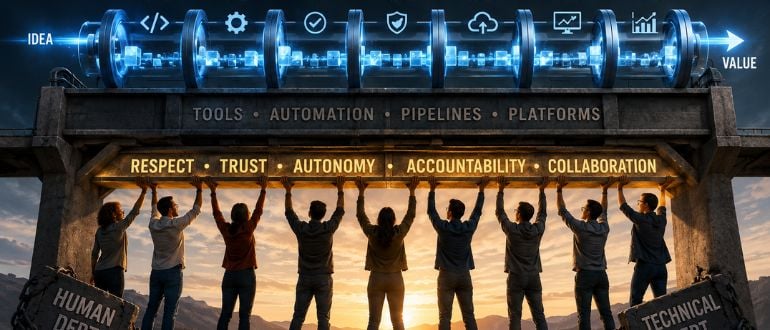

DevOps has always carried a larger purpose than installing tools, automating pipelines, or improving deployment frequency. Those things matter. I have spent much of my career helping organizations make those things work. Yet the deeper purpose of DevOps is to improve the flow of value through a complex socio-technical system. The system includes tools, platforms, pipelines, environments, tests, controls and production operations. It also includes people, leadership behavior, decision rights, accountability, learning, fear, confidence and trust.
The technical side is easier to see. A failed build is visible. A broken deployment is visible. A production incident is visible. The human side usually fails more quietly. People stop speaking up. Teams wait for permission. Architects argue in private. Security arrives late. Operations becomes defensive. Leaders ask for more status. Engineers learn which truths are safe to tell and which truths create trouble. The organization continues to run, and the dashboards may still look respectable, while the real delivery system becomes slower and more brittle.
This is where respect and trust belong in the DevOps conversation. They are frequently treated as soft values, which is one reason many organizations under-engineer them. In real operating environments, respect and trust behave like system properties. They influence how quickly decisions move, how early risk is surfaced, how honestly teams inspect their own work, how safely people challenge weak assumptions, and how much effort is wasted protecting against blame.
When respect and trust are healthy, DevOps practices have room to work. When they degrade, DevOps practices turn into a ceremony. The pipeline may still exist, the backlog may still be groomed, and the incident review may still be scheduled. The flow of confidence has already been damaged.
I learned this lesson in a very practical way when I joined an early-stage manufacturing company as Engineering VP. I was hired to lead five product engineering teams that had been reporting through a senior engineering executive, whom I will call Tom. From the beginning, something felt odd. The company wanted me to lead the same teams Tom already controlled. I was told the company had growth plans and other plans for Tom, which sounded reasonable enough, although the operating reality was still unclear.
During interviews, most executives asked thoughtful questions about leadership, organization, delivery, and growth. Tom’s questions were different. He focused almost entirely on technical details at a level that felt misplaced for the senior leadership role I was being hired to perform. Later, when I spoke with engineering managers and principal engineers, I saw the same pattern. They were more interested in testing my technical opinions than understanding how I would lead, set direction, develop managers, and improve delivery.
That told me something important. The engineering organization had learned to respect technical control more than engineering leadership. Leadership was viewed as soft and fluffy, a pleasant wrapper around the real work of technical decision making. Yet the performance evidence did not support that belief. A lot of interesting engineering work was being done, but products were not reaching production on schedule and quality goals were being missed.
The deeper problem became clear after I joined. The five product teams had become dependent on Tom for many small decisions. People were waiting for Tom. When Tom reviewed work, he often asked for changes. Some changes may have been useful. Many became part of a larger pattern in which engineers learned that moving forward without Tom’s blessing carried risk. Over time, his criticism created fear. Engineers stopped speaking up even when they believed his direction was incorrect or over-engineered. They did not feel respected, and they did not trust his decisions.
This is the kind of condition I now describe as Human Debt. Technical Debt is familiar to engineering organizations. It accumulates when technical shortcuts, deferred design, weak tests, brittle architecture, and neglected maintenance make systems harder to change. Human Debt accumulates when unresolved trust violations and cultural shortcuts make people harder to engage. It shows up as hesitation, silence, risk avoidance, passive compliance and loss of ownership.
Human Debt and Technical Debt often grow together. In this organization, delayed decisions and over-control created rework. Fear reduced candor. Lack of trust slowed judgment at the edge. Engineers waited for approval instead of using their expertise. Technical decisions became more complicated because the human system had become complicated. The delivery failure was visible in missed schedules and quality problems. The deeper failure was low respect and low trust.
After I joined, Tom was reassigned to a one-person research role. My main responsibility was to restore the organization’s ability to deliver. I did that by treating the five teams as product teams with real accountability for outcomes. They needed clear goals, decision authority, and the confidence to use their own judgment. My role was to set direction, remove obstacles, provide resources, and recognize accomplishment. I avoided stepping into every technical detail because that would have rebuilt the same bottleneck with a different person sitting in the chair.
The change required patience. People who have learned to wait do not immediately become autonomous because a new leader says they are empowered. They test the new system. They watch what happens when someone disagrees. They notice whether leaders punish mistakes or learn from them. They listen for whether respect is real or merely part of the management vocabulary.
I encouraged managers and engineers to speak up, challenge assumptions, simplify where possible, and make decisions within their areas of responsibility. I set goals and rewards around accomplishment. I made it clear that leadership in engineering is not the act of having the strongest opinion about every technical detail. Leadership is the work of creating the conditions in which capable people can do their best work.
Within a year, the organization was performing well. All five product teams were shipping new products. Delivery improved. Quality improved. Human Debt decreased because people felt respected again. Technical Debt decreased because teams could finally make responsible engineering decisions without endless rework for approval. The result came from clear goals, autonomy, feedback, accountability, and recognition.
That experience shaped how I think about DevOps. The visible delivery system and the human delivery system are inseparable. A DevOps value stream is carried by people who either trust the system enough to expose reality or protect themselves from the system by hiding it. The pipeline can automate the movement of artifacts. It cannot compensate for fear.
Respect is the foundation of this human architecture. It is the structural integrity that keeps people aligned under stress. Respect is visible in how reviews are conducted, how disagreements are handled, how decisions are explained, and how people closest to the work are treated. A respectful engineering organization still has hard conversations. It still rejects weak designs, corrects poor assumptions, and insists on quality. The difference is that people experience the correction as part of shared responsibility rather than personal diminishment.
Trust functions as the control plane. It shapes how decisions flow, how risk is taken, and how teams adapt when conditions change. In low-trust organizations, controls multiply. Approvals increase. Ticketing expands. Documentation becomes defensive. Escalations become routine. Each added control may appear responsible in isolation, but the combined effect is often delay and frustration. In high-trust organizations, authority moves closer to the people with the best information. Governance becomes clearer because people understand the purpose of boundaries and the reasons for decisions.
Trust does not remove governance. It makes governance more rational. Architecture decisions should be visible. Trade-offs should be explained. Reversals should be acknowledged. Decision logs should be accessible. When people understand how decisions are made, suspicion decreases. When suspicion decreases, flow improves.
This matters deeply for DevOps because the essence of DevOps is faster confidence. Every successful deployment represents a chain of respectful interactions. Developers trust operations to deploy safely. Operations trusts developers to test thoroughly. Security trusts teams to surface risk early. Product leaders trust engineering judgment. Engineering teams trust leadership to remove fear from experimentation and learning. A pipeline is therefore more than an automation path. It is a trust architecture expressed through technical flow.
The same logic applies to SRE. Reliability is a social promise expressed through technical metrics. Service Level Objectives, Service Level Indicators, and error budgets create shared language for balancing innovation and reliability. When respect is weak, reliability conversations become enforcement. When trust is weak, reliability becomes political. When respect and trust are strong, SRE gives teams a disciplined way to make risk visible and manageable.
Security follows the same pattern. In many organizations, security is experienced as late control, which creates friction and distrust. Strong security requires verification, accountability, and resilience. It also requires teams to bring risks forward early. People report vulnerabilities sooner when they trust the response. They ask better questions when they feel respected by security partners. Controls work better when people understand them and believe they are fair.
AI makes this entire discussion more urgent. AI can improve productivity and creativity, yet it also introduces anxiety about judgment, relevance, displacement, and control. AI magnifies the system it enters. In a respectful and trusted organization, AI can extend human capability. In an organization already carrying Human Debt, AI can accelerate fear and disengagement. People begin to wonder whether decisions will be made with them or around them.
Leaders should treat that concern as operational information. In technical systems, we instrument what matters. We collect logs, metrics, traces, and events because they help us see what the system is doing. Human systems need observability as well. Work visibility helps people understand how work is flowing. Interaction visibility shows where collaboration is healthy or strained. Sentiment visibility helps leaders understand how people are experiencing change. Commitment visibility reveals whether stated values and actual behaviors match.
This is disciplined listening. It is also practical engineering management. Silence is a signal. Constant waiting is a signal. Defensive escalation is a signal. Repeated rework is a signal. A team that has stopped raising risks is sending feedback as surely as a service emitting error logs.
The purpose of measuring respect and trust is to make invisible friction visible. Metrics should never replace leadership judgment, and they should never become weapons. Used well, they help leaders see where the human system is degrading before the technical system fails. Fairness perception, decision latency, escalation frequency, postmortem quality, feedback-to-action ratios, early risk reporting, and cross-team participation can all tell us something useful about the health of the delivery system.
Respect and trust also need cadence. They decay when they depend only on individual personality or good intentions. Retrospectives, decision reviews, listening sessions, postmortems, scorecards, and leadership follow-through create rhythm. Rhythm creates reliability. People need to know where concerns can be raised, how decisions will be explained, and how learning will be captured. A human system, like a technical system, becomes resilient through design, operation, feedback, and maintenance.
This brings us back to the practical work of DevOps leadership. Look at the places where people are waiting for permission. Look at the places where decisions are opaque. Look at the reviews where people leave diminished rather than clearer. Look at the controls that exist because trust has failed. Look at the recurring Technical Debt that may have Human Debt beneath it.
Then improve the system. Make decision processes visible. Move authority closer to the work where it is safe and sensible to do so. Reward early problem discovery. Protect honest retrospection. Treat postmortems as learning mechanisms. Use governance as respect in action. Make feedback predictable. Explain trade-offs. Recognize accomplishment. Reduce the avoidable fear that slows professional judgment.
DevOps will continue to evolve through platforms, AI-assisted engineering, intelligent operations, and new forms of automation. The human architecture will still matter. Tools will change. Pipelines will change. Operating models will change. People will still need respect in order to contribute their best judgment. Teams will still need trust in order to move with confidence.
Respect and trust are DevOps engineering disciplines. They shape flow, quality, security, reliability, and adaptation. Organizations that engineer them intentionally will deliver with more confidence. Organizations that ignore them will keep rediscovering that even the best technical systems are limited by the human systems that operate them.