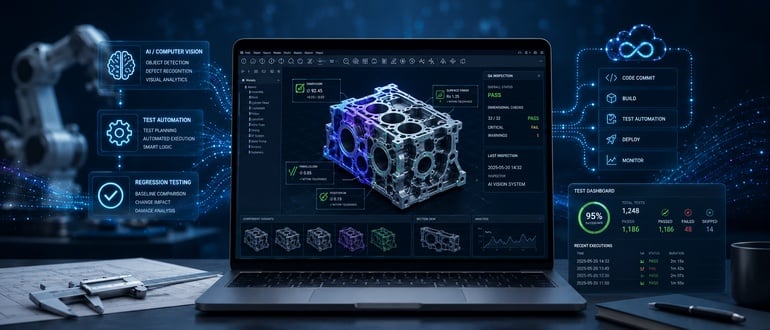

SmartBear this week extended its ability to apply artificial intelligence to application testing with the addition of a computer vision capability that can be used to detect objects in applications.
Prashant Mohan, vice president of product at SmartBear, said the company’s TestComplete platform now combines computer vision and optical character recognition to help automate the testing of highly visual applications such as CAD/CAM applications that have 3D components.
Historically, those types of applications relied heavily on manual testing processes that created a bottleneck that slowed the rate at which more complex applications could be deployed, he added. Computer vision capabilities, in effect, now allow machines to visualize these applications in the same way that humans see them, noted Mohan.
As a result, the SmartBear platform is now able to test how an application is supposed to behave, rather than how its underlying code is supposed to function. That not only makes tests more resilient to subtle application changes, it also serves to make them easier to maintain because DevOps teams can automate regression tests to keep pace with application changes without having to revise code, said Mohan.
As the pace at which these applications are being constructed accelerates in the age of AI, the need to apply computer vision to test them is becoming that much more pressing, said Mohan. The challenge is providing that capability within the context of a platform that is already being used to test a wide range of other classes of applications, he added.
Mitch Ashley, vice president and practice lead for software lifecycle engineering at the Futurum Group, said as AI compresses how fast applications get built, regression suites anchored to code structure accumulate maintenance debt with every release. Perception-based verification narrows that gap, but the harder problem is folding it into a platform already testing many other application classes, he added.
A recent Futurum Group survey finds well over a third of organizations (37%) have adopted AI-assisted testing, a percentage that should steadily increase as various forms of AI are incorporated into automated testing platforms.
In the meantime, DevOps teams should revisit workflows because more untested code is finding its way into production environments than most DevOps teams would care to admit. As it becomes simpler to both create and run tests, there increasingly becomes fewer valid reasons for not running those tests. After all, one issue discovered in production can negate return on investment (ROI) that a DevOps team might have delivered using AI tools to write code faster.
Of course, not two DevOps teams have the exact same level of maturity. There are a few organizations that have dedicated teams that religiously test every line of code, while others assume individual developers have taken on that responsibility. While developers should test their code to some degree, there is always going to be a need for third-party validation. No developer is going to understand all the possible permutations of a potential vulnerability in their code. The issue, as always, is determining how best to strike the right balance.