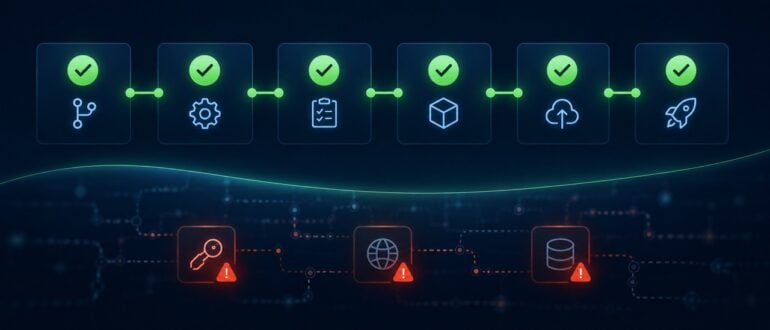

These days, when a developer needs a CI/CD pipeline, they don’t always dive into GitHub Actions docs or spin up Jenkins from scratch. Instead, they pull up an AI assistant and type out something like:
“Create a deployment pipeline for a containerized application.”
Seconds later, the AI spits out a complete workflow. It looks polished. It builds, tests, packages, and deploys, clean syntax, logical steps, just what you’d expect. The developer copies the code, tweaks a few bits, throws it in the repo.
The pipeline works.
The deployment goes through.
The team checks it off and moves along.
This is just standard practice now. More and more, teams are using AI to pump out infrastructure code, deployment workflows, Kubernetes configs, and all sorts of automation scripts. Stuff that used to take specialized know-how gets built almost instantly.
Productivity shoots up. That’s obvious.
But the risks aren’t so easy to spot.
And that’s what makes AI-written DevOps pipelines dangerous. They look right, they even work as intended. But sometimes, they hide big problems that don’t come out until much later.
Why Are AI Generated Pipelines So Popular?
Part of it is the pressure DevOps teams face. Speed matters, a lot. Every new project needs a workflow or deployment setup. Infrastructure needs scripts and automation right away. The push for shorter delivery cycles, fewer manual steps, and more reliability isn’t going anywhere.
So, AI assistants fit the bill. Instead of losing time sifting through documentation, developers just describe what they need. The AI gives them something that works immediately.
For small teams, it feels like hitting the jackpot.
You end up spending less time wrestling with configs and more time building features. Those repetitive deployment patterns? They’re just a prompt away now. Suddenly, you’re delivering faster than ever.
The kicker isn’t that AI writes these pipelines. The problem is people tend to trust what they get, even if they don’t really understand it.
Just Because It Works Doesn’t Mean It’s Right
Here’s where things get tricky. Most of the time, AI produced pipelines seem perfect.
Build passes.
Tests succeed.
Deployment finishes without a hitch.
Everything looks fine at a glance.
But pipelines do more than move code. They manage secrets, access production, spin up infrastructure, touch cloud resources, serious stuff.
A pipeline can do its job and still leak secrets, have permissions set way too wide, or bake in security holes.
Most of these issues don’t stop things from working. They usually just lurk unnoticed, sometimes for months, until something breaks or someone finds them.
The Permissions Trap
This comes up a lot. AI generated workflows often grant broad permissions. It’s safer, from the AI’s perspective, to give the workflow access to everything it might need, just to make sure nothing fails.
From a user’s angle, success means no errors. From a security angle, success means only granting what’s absolutely necessary. Those aren’t the same thing.
Now, you’ve got pipelines that can do way too much. Maybe they can write to areas of your repo they shouldn’t, or reach into sensitive environments no script should ever touch.
Nothing seems wrong until those permissions get abused or leaked.
And most of the time, nobody even realizes it’s a risk.
Hidden Security Gaps
AI just predicts code patterns. It doesn’t know your organization’s security standards, compliance rules, or governance policies. It doesn’t actually understand what safe means to you.
That means it’ll happily generate pipelines with questionable practices that look harmless on the surface.
Secrets might get handled sloppily.
You might end up pulling in third-party actions without checking them out.
Dependencies come from external sources, maybe unverified.
Deployment steps run commands nobody’s really reviewed.
None of these are guaranteed to spark a breach. But they definitely raise the odds.
Supply Chain Problems
Today’s delivery pipelines are built on tons of external stuff, GitHub Actions, container images, plugins, scripts, you name it. And because AI is trained on all sorts of public code, it tends to pull in whatever’s commonly used out in the wild.
That’s what makes the workflow work, familiar ingredients.
But the AI has no clue if you actually trust those components in your environment.
Something that looks safe now gets compromised later. Some dependency gets a silent update that changes its behavior. Or maybe a container image carries vulnerabilities only a deep review would catch.
Teams that copy and paste AI output without checking every piece inherit whatever risks those pieces carry without knowing it.
Speed Kills Review
Building a pipeline used to take effort. Engineers read docs, figured out integrations, and picked every step intentionally. That process forced you to review everything as you went.
AI blew that up.
Now you can generate pipelines much faster than you can realistically review them.
So, teams start to focus on “does it work?” and forget about “is it safe?”
The quicker these pipelines get created, the easier it is to skip a real review.
Fast tools are great until they become a shortcut past critical thinking.
Blind Trust Creeps In
As AI gets better, people start trusting its output. It’s human nature.
But here’s the downside. When the AI nails it, teams stop double checking what it gave them. There are pipelines running right now that went live six months ago, and nobody knows exactly what they do. New hires inherit them, assuming someone else reviewed everything. The people who set them up assume the previous team made careful choices. Over time, trust quietly replaces inspection.
And risks pile up in the background.
So, How Should Teams Use AI?
The answer isn’t to ditch AI. Far from it. AI assistants save time, kill boring work, and help you move faster.
But you have to treat generated pipelines as just a starting point, not a finished product.
Every AI generated workflow deserves real scrutiny, the same way you review core app code.
Check the permissions.
Validate how secrets get handled.
Review all third party pieces.
Don’t let anything run in production you don’t fully understand.
It’s not about slowing down innovation. It’s about not letting automation erase your awareness.
Looking Ahead
AI will keep getting better at DevOps work. Systems will generate smarter workflows, design deployment strategies, optimize infrastructure, and maybe even decide when to automate crucial operations.
That’s exciting stuff. But it makes governance and review even more critical.
The winners will be the teams who automate fearlessly but never check their brains at the door. Automation is only as good as your willingness to keep paying attention.
Final Thoughts
AI generated pipelines aren’t some distant future, they’re already part of everyday work for a lot of engineers. They’re fast, simple, and they boost productivity.
But just because a pipeline runs smoothly doesn’t mean it’s secure.
The real danger isn’t that AI makes broken workflows. It’s that it makes seemingly perfect workflows that quietly carry hidden risks.
Automation has always been DevOps’ superpower, but it only works when you still know what your systems are actually doing behind the curtain.
AI shakes up how teams build, but it doesn’t get you off the hook for visibility, accountability, or good judgment.
You can generate a pipeline in seconds. The fallout from a bad one could stick with you for years.