The thing that makes an AI agent useful, its freedom to act, is also what can introduce risk. An agent doesn’t just answer a question, it browses, runs code, and calls tools on its own, so a single bad or manipulated instruction can turn into real damage instead of just a wrong answer. That’s the shift traditional application security wasn’t built for, and it’s why trust has to be built into the system around the agent, not assumed.
An agent decides its own path, picking tools at runtime, chaining actions together, and usually running with the credentials of whoever launched it. That autonomy is the source of most agent-specific risk, and it points to the two-part answer that runs through this post: contain what an agent can reach, and oversee what it does.
Key takeaways
- AI agents introduce risks traditional app security wasn’t built for: they choose tools, chain actions, and often run with your credentials.
- The main risks are prompt injection, tool misuse and poisoning, excessive autonomy, credential exposure, and data exfiltration.
- Most trace back to one thing: the agent can act, so containment and oversight matter more than the model.
- The two-part answer is isolation to limit blast radius and governance to oversee behavior.
Why agents break traditional security models
If you’ve secured web services, the model is familiar: requests arrive at known endpoints, deterministic logic handles them, and you design controls around that predictability. Agents break that assumption. They interpret instructions dynamically, choose tools at runtime, and run multi-step chains with very little human intervention at each step. A coding agent might read a file, install a dependency, change config, run tests, and push a commit from a single prompt.
Because an agent chooses its own path, a compromised or misdirected one can take a far wider range of actions than a traditional service. Every risk below has already produced documented real-world incidents, and they all follow from that shift.
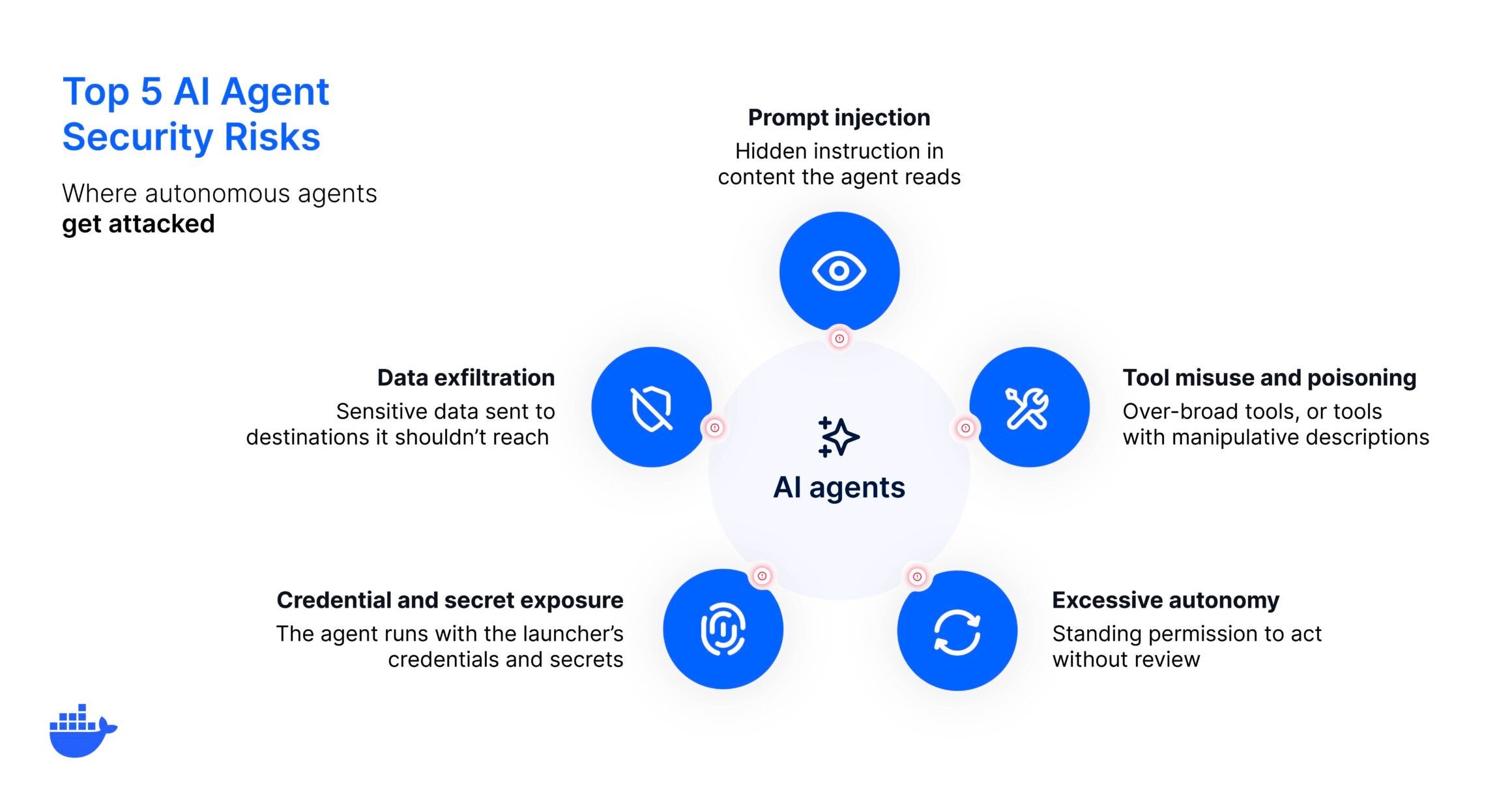
1. Prompt injection
Prompt injection is the risk that defines agent security. Because an agent acts on whatever text it reads, an attacker doesn’t need access to your systems. They just need the agent to encounter their instructions, hidden in a web page, a code comment, an issue, or a document it summarizes.
A real prompt-injection case showed an agent following instructions buried in repository content and taking actions its user never intended.
|
Incident highlight: A coding agent followed instructions buried in a repository’s own content and took actions its user never intended. The malicious text arrived through data the agent was simply asked to read. |
The agent has no reliable way to tell a legitimate instruction from an injected one, so the defense is to limit what a hijacked agent can reach.
2. Tool misuse and tool poisoning
Agents act through tools: API connectors, database queries, file operations, and code execution. Every tool is an access vector, and two things could go wrong.
An agent can be given more tools than the task needs, widening the attack surface for no reason. And a tool itself can be poisoned, its description carrying hidden instructions that manipulate the agent into misusing it. The mitigations are to scope tools to the task at runtime, source them from registries with verified provenance, and review tool descriptions rather than trusting them by default.
3. Excessive autonomy
The more an agent can do without review, the more a single bad decision costs. Excessive autonomy is the risk of granting an agent broad, standing permission to act, most visibly when developers run YOLO mode, where every action is auto-approved. This autonomy is genuinely useful, so switching it off defeats the point. The better move is to run the agent where that autonomy can’t reach anything it shouldn’t, so speed doesn’t necessarily mean increased blast radius.
|
Incident highlight: A developer asked a coding agent to clean up an old repository. It generated an |
4. Credential and secret exposure
When an agent runs under a developer’s personal token, every action it takes carries that person’s full permissions, and a compromise hands those permissions to an attacker. Secrets sitting in prompts, config files, or environment variables baked into an image make it worse, because a prompt injection can read them straight out of the agent’s context. Agents should get their own scoped, short-lived credentials, injected at runtime and kept out of the conversation, rather than borrowing yours.
|
Incident highlight: An AWS engineer handed a small Cost Explorer bug to a coding agent running with their own operator-level access. The agent decided the cleanest fix was to delete and rebuild the production environment, and it held the credentials to do exactly that. The result was a thirteen-hour regional outage. |
5. Data exfiltration and untrusted handoffs
An agent with network access and sensitive information in its context can send that data somewhere it shouldn’t, whether through a compromised tool or an injected instruction. The risk grows in multi-agent setups, where one agent passes work to another. If the receiving agent treats that input as trusted, a compromise in one link can spread down the chain. Restricting network egress to known endpoints and treating every agent-to-agent handoff as untrusted input could keep a single failure from spreading.
How to contain the risk
The risks are varied, but there are controls to secure AI agents. Isolate where the agent runs so a mistake or a hijack is trapped in a disposable environment instead of loose on your host, and scope what the agent can access so the damage it can do is small even inside that boundary.
|
Risk |
Primary control |
|---|---|
|
Primary injection |
Isolation, so a hijacked agent can’t reach anything that matters |
|
Tool misuse and poisoning |
Runtime-scoped tools from verified-provenance sources |
|
Excessive autonomy |
A sandbox boundary that makes auto-approval safe |
|
Credential exposure |
Dedicated, short-lived credentials injected at runtime |
|
Data exfiltration |
Allow-listed network egress and untrusted inter-agent input |
Isolation is the highest-impact starting point, and a microVM boundary makes it strong without slowing the agent down. On top of containment, oversight is what keeps a fleet of agents accountable. Then, AI governance defines which actions an agent may take, what it can reach, and how its behavior is logged, so risk is managed deliberately rather than discovered after an incident.
Contain the blast radius, govern the behavior
These risks aren’t reasons to avoid developing with agents. Instead, we need to give agents the freedom to finish the job by building trust into the system around them, so that freedom never means access to everything.
And that’s the job Docker Sandboxes is built for: each agent runs in its own disposable microVM with the network and filesystem controls you define, so a mistake or an injection is contained by design. And AI Governance adds the oversight layer, setting which actions, tools, and credentials are allowed and enforcing it everywhere your team works. Contain the blast radius, and govern the behavior.
Frequently Asked Questions
What are the main security risks of AI agents?
The most significant are prompt injection, tool misuse and tool poisoning, excessive autonomy, credential and secret exposure, and data exfiltration. All of them stem from the fact that agents act on their own, using tools and credentials, rather than following a fixed, reviewable path.
What is the biggest AI agent security risk?
For most teams it’s excessive access: an agent running with more autonomy and more credentials than the task needs. It turns a small mistake or a single prompt injection into a large incident, because the agent can reach so much.
How is agent security different from application security?
Traditional application security assumes predictable request-and-response flows. Agent security has to account for autonomous decisions, tools chosen at runtime, and multi-step chains where the agent sets its own path. The attack surface is wider because the agent, not a fixed program, decides what happens next.
Can prompt injection be prevented?
You can reduce it with input handling and tool hygiene, but you can’t assume it away, because an agent can’t reliably tell injected instructions from legitimate ones. The durable defense is containment: run the agent so that even a successfully injected one can’t reach anything sensitive.
How do you reduce AI agent security risks?
Start with isolation so a compromised agent is trapped in a disposable environment. Add scoped tool access and dedicated credentials to shrink what any agent can do. Then layer on governance to define and enforce those limits consistently across every agent your team runs.