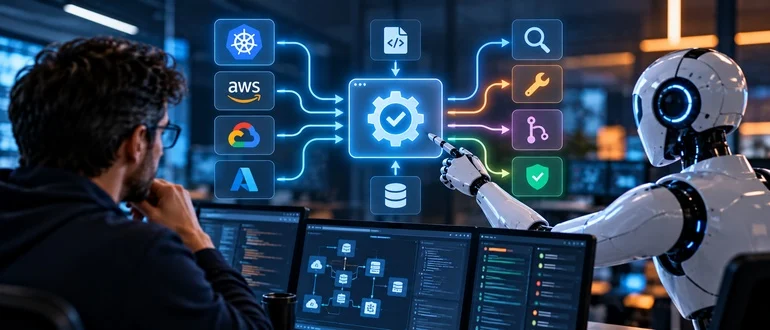

env zero today revealed it is making available, under an early access initiative, a control plane for agentic engineering workflows that automatically detects divergence, decides what the correct response should be based on policies defined by a DevOps team, and executes the remediation.
Announced at DevOpsCon & AI Platform Engineering Day event, EZ Control is designed in a modular fashion, starting with a configuration management database (CMDB) that env zero gained with its acquisition of CloudQuery.
Company CEO Steve Corndell said that, on top of that database, env zero has added an ontology layer that spans 80 plugins spanning nearly 2,300 resource types, including Kubernetes clusters and multiple cloud services from Amazon Web Services (AWS), Google, and Microsoft. That ontology ensures that every resource is continuously linked to the code that declared it, the team that owns it, the cost it carries, the resources that depend on it, the policies that apply to it and the risks and insights associated.
Accessed as a software-as-a-service (SaaS) application that requires no instrumentation code to be injected into a DevOps workflow, the EZ Control plane then leverages that topology and ontology to enable DevOps teams to express an intent in natural language that is converted into an autonomous workflow that includes all the context needed to be successfully applied, said Corndell. Every action follows the repository and review process that owns the resource. A post-fix scan then verifies closure to ensure a workflow is always attributable, reversible and auditable either by a human or another AI agent accessing a built-in Model Context Protocol (MCP) server.
DevOps teams can also tune the level of automation applied via EZ Control to observe only, propose a fix, act with approval, or act autonomously within defined guardrails. Within those limits, EZ Control corrects unintentional drift by reapplying IaC, captures intentional changes as a pull request against the owning repository, and flags defects in the source code for correction.
Designed to work with multiple infrastructure-as-code (IaC) languages rather than requiring DevOps teams to standardize on OpenTofu or Terraform, env zero is encouraging DevOps teams to adopt the entire platform but is also making individual components available separately to meet DevOps teams where they are on their AI journey, said Corndell.
Of course, no two DevOps teams are at the same place on that journey, but they will all eventually encounter the same AI agent management issues. AI agents provisioning infrastructure at machine speed creates resources that legacy IaC tools never see. The result is a widening gap because software engineers have no visibility into or control over an agentic engineering workflow.
It’s still early days so far as adoption of agentic engineering workflows is concerned, but it’s apparent that DevOps teams are being overwhelmed by the amount of code being generated by AI tools. As that volume increases, the more pressing the need to automate DevOps workflows becomes. That challenge, as always, is finding a way to achieve that goal at scale without requiring a small army of software engineers to maintain it.