

Ask any engineering team whether they have test coverage, and most will say yes. Ask them whether they trust what that coverage is actually telling them before a deployment, and the conversation gets more complicated.
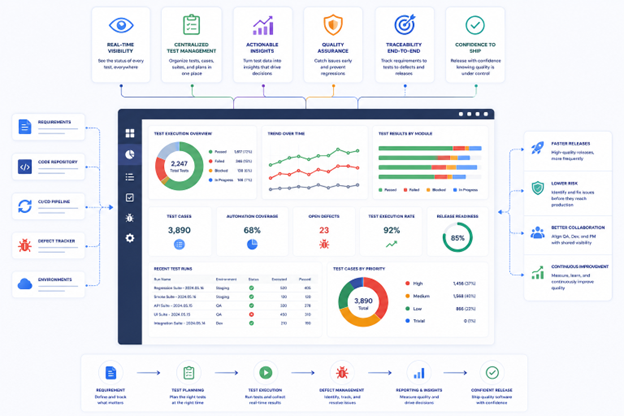
The gap between having tests and having visibility into what those tests mean is where most deployment anxiety lives. Teams with extensive automated test suites still pause before major releases. Teams with high coverage percentages still experience production incidents from regressions that should have been caught. The tests exist. The confidence does not always follow.
Test management tools are supposed to close that gap. In practice, how much they close it depends almost entirely on how they are used — and most teams are using them for the wrong thing.
The Difference Between Tracking Tests and Understanding Coverage
The most common use of test management tools is organizing and tracking test cases. Which tests exist, which ones ran, which ones passed, which ones failed. This is useful as far as it goes. It gives teams a record of testing activity. It does not give them visibility into what that activity actually means for the risk profile of a specific deployment.
Coverage visibility and coverage tracking are different things. Tracking tells you what happened. Visibility tells you what it means.
A team with genuine coverage visibility can look at a proposed deployment and answer specific questions. Which test cases cover the code areas that changed in this release. Whether those test cases reflect current system behavior or were written against behavior that has since changed. Whether there are gaps in coverage for the services most likely to be affected by this specific change. Whether the test cases that passed have been passing consistently or intermittently.
A team with only coverage tracking can tell you that tests ran and passed. That information is less useful than it sounds when the tests that passed may not be the ones relevant to what just changed.
The shift from tracking to visibility is what test management tools make possible when they are connected to the right information sources and used to answer deployment questions rather than just produce activity reports.
What Visibility Actually Requires
Visibility into test coverage requires three things that most teams treat as separate concerns but that test management tools can bring together.
The first is traceability between test cases and the code they cover. When a developer changes a specific service or module, the relevant question is not whether the overall test suite has adequate coverage. It is whether the test cases covering that specific area are current, comprehensive and passing consistently. Without explicit traceability between test cases and code areas, this question cannot be answered from a test management tool. With it, the answer is available in seconds.
The second is currency of test case behavior. A test case that was accurate six months ago is not necessarily accurate today. In systems where services deploy independently on their own schedules, test cases covering service interactions can drift from current behavior without anyone noticing. The test still runs. It still produces a result. However, the behavior it is validating may no longer reflect how the service actually behaves.
This is where the source of test cases matters more than most teams realize. Test cases written against API documentation or developer assumptions about service behavior start drifting immediately. Test cases sourced from recorded real interactions stay current because they reflect what services actually do rather than what someone expected them to do.
Keploy addresses this specifically as an open-source API testing tool — it captures real HTTP traffic from running services and generates test cases from those actual interactions. When those generated test cases feed into a test management workflow alongside manually authored ones, the coverage picture that the tool surfaces reflects current service behavior rather than historical assumptions. The visibility the test management tool provides is only as accurate as the test cases it is organizing, and test cases grounded in real traffic carry significantly more accuracy than test cases grounded in documentation.
The third requirement is change-aware reporting rather than aggregate reporting. Most test management tool dashboards show aggregate statistics — overall coverage percentage, total test count, pass rate across the full suite. These numbers are useful for understanding long-term trends. They are not useful for making a deployment decision about a specific change.
Change-aware reporting asks different questions. Given the code areas modified in this release, which existing test cases cover them. Of those test cases, which have been passing consistently, and which have been flaky. Are there coverage gaps in the affected areas that should be addressed before this change ships. This kind of reporting requires test management tools to understand the relationship between code changes and test coverage — not just to aggregate test results.
How This Changes Deployment Decisions
When test management tools provide genuine visibility rather than just tracking, the quality of deployment decisions changes in a specific way.
Before visibility, deployment decisions tend to be binary. The tests passed, so we are deploying. The tests failed, so we are not. There is no graduation between these states. Either the pipeline is green, or it is red.
With visibility, deployment decisions have more information. The tests passed. The coverage for the changed areas is current. The test cases covering the highest-risk integration points have been passing consistently. There are no known coverage gaps for the services affected by this release. That is a substantively different deployment decision than the one based only on a green pipeline.
The converse is also more informative. The tests passed, but the coverage for the authentication service — which was modified in this release — has not been updated since the last API contract change three months ago. That is a signal worth investigating before deploying, regardless of what the pipeline says.
Neither of these deployment decisions is available without visibility. They require test management tooling that connects test results to coverage information, traces coverage to specific code areas and surfaces gaps and currency issues rather than just pass/fail aggregates.
What Teams That Ship Confidently Actually Do
The engineering teams that consistently ship with genuine confidence rather than hope tend to share a few practices that distinguish how they use test management tools from how teams that struggle to use them.
They review coverage as part of code review rather than as a separate QA activity. Before a significant change merges, someone checks whether the existing test cases adequately cover the affected area and flags gaps that should be addressed before the change ships. This moves coverage from a post-deployment concern to a pre-merge one.
They treat coverage gaps as information rather than as failures. When test management tools surface an area of the system with incomplete or outdated coverage, the response is not to block the release automatically, but to understand the risk. Sometimes the gap is in a low-risk area, and the deployment proceeds with awareness. Sometimes the gap is in a critical path, and it gets addressed first. The difference between these two outcomes requires visibility that a pure pass/fail pipeline cannot provide.
They maintain test case currency as an ongoing practice rather than a periodic cleanup. When a service changes its API contract, the test cases covering that service get updated alongside the change rather than eventually. This is easier to sustain when test management tools make coverage currency visible — stale test cases are flagged before they accumulate into a systemic problem.
Conclusion
The gap between having tests and having genuine coverage visibility is not a tooling gap in the sense of needing better test runners or more sophisticated CI platforms. It is a visibility gap — a gap in what test management tools are being used to surface and how that information connects to deployment decisions.
Teams that close this gap do not necessarily have more tests than teams that do not. They have a clearer picture of what their tests are telling them. They understand which areas of the system are protected, where the gaps are and whether the test cases they are relying on still reflect current system behavior.
That picture is what test management tools exist to provide. The teams that use them to build it are the ones that ship with confidence — not because nothing ever breaks, but because they understand their actual exposure before they deploy rather than discovering it afterward.