Sandbox testing works well when your team controls both sides of the integration. You define the service, you define the mock, you know exactly what the sandbox should return. That setup holds up fine for internal microservices and first-party APIs.
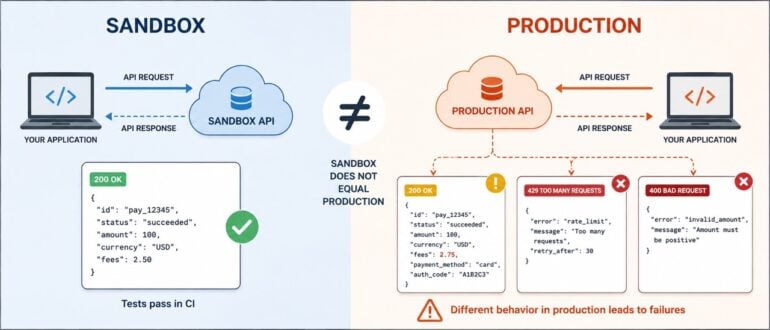
It starts to break down when you don’t own the dependency. Payment processors, identity providers, SMS gateways, banking APIs, shipping integrations—these are services your system depends on but can’t fully replicate. Their providers give you a sandbox environment, but that sandbox is a simulation they maintain, not a mirror of what production actually does. The gap between the two is where production incidents are born.
Sandbox Drift Is Quieter Than You Think
Teams writing integration tests against third-party sandboxes are placing a bet. The bet is that the sandbox accurately reflects how production behaves today, not six months ago when someone last checked. That bet loses more often than teams expect.
Provider sandboxes lag behind their production counterparts for reasons that are entirely understandable and entirely inconvenient. A new field appears in a webhook payload in production weeks before the sandbox documentation even mentions it. Rate limiting logic runs differently across environments. Error codes that surface in specific production failure scenarios have no sandbox equivalent at all. Authentication token formats quietly shift in production while the sandbox keeps returning the old structure.
Maintaining perfect sandbox parity is expensive work that providers deprioritize against shipping actual product features. The consequence lands on your test suite, which ends up validating behavior against an environment that diverged from production months ago without announcing itself.
The failure mode plays out the same way across teams. Tests pass in CI. The deploy goes out. Something in the real integration behaves differently from what the sandbox testing returned, and the investigation surfaces a discrepancy that had been sitting there quietly for weeks.
What Actually Needs Testing in API-Heavy Systems
The sandbox drift problem is one layer. Underneath it are several distinct problems that surface when external dependencies are involved, each requiring a different approach.
Request and response shape validation is the most basic layer. Does your code handle the response structure the provider actually sends, including optional fields, null values, and edge-case formats? Sandboxes help here when current, and hurt when they’re not.
Error path coverage is where most sandbox-based test suites fall short. You need to exercise what happens when a payment API returns a 402, when an identity provider times out, when a webhook arrives out of order. Provider sandboxes vary considerably in how well they support failure simulation. Some are genuinely useful for this. Many others treat the happy path as the entire surface.
Behavioral consistency over time is something no sandbox addresses directly. The question isn’t just whether your code handles today’s API response correctly. It’s whether a change to your codebase broke something that was working before. For that, you need a stable test baseline that doesn’t shift because a provider updated their environment on their own schedule.
State management deserves more attention than most teams give it. Certain integrations create side effects inside the provider’s environment—records, events, audit logs—that carry over between test runs. Provider sandboxes handle this inconsistently. Some make it straightforward to isolate test state or reset between runs. Others leave tests sharing state in ways that surface as intermittent failures with no obvious cause, the kind that take a long time to diagnose because nothing in the test output points at the real problem.
Approaches That Hold Up Under Real Conditions
Teams that test API-heavy systems reliably tend to share a few things in common, and it’s not that they found a better sandbox.
They don’t treat provider sandboxes as their regression baseline. Sandboxes are useful for exploratory testing, for validating a new integration before it goes to production, and for smoke testing after a provider ships changes. They’re not stable enough to anchor your regression suite against, because the environment itself changes independently of your code.
They record real API interactions and use those as test fixtures. Capturing actual responses from a provider’s production or sandbox API at a specific point in time, then replaying those during CI, gives you a stable baseline you control. Tools that support HTTP traffic capture and replay—whether that’s Keploy, Hoverfly, or WireMock in recording mode—solve this by anchoring tests to observed behavior rather than simulated behavior. When the provider updates their API, you update your fixtures deliberately, with full awareness of what changed.
They test failure conditions explicitly rather than hoping the sandbox will produce them on demand. This means writing specific fixtures for error responses, timeouts, and malformed payloads. It means not leaving error path coverage to chance.
They version-control their mocks and fixtures alongside their code. When a provider updates their API, the fixture update is a deliberate code change with a commit message that explains why. Six months later, when something breaks, that commit history is sitting right there. Compare that to debugging a sandbox drift issue where nobody knows when the environment changed or what exactly shifted.
The Contract Testing Conversation
Contract testing gets raised often enough in this context that it’s worth being direct about the boundary of what it covers.
The core idea: your code sends a request, expects a certain response shape, and a contract test validates that both sides of that agreement hold. Pact handles this reasonably well for teams that can run tests against the actual provider API or a stub the provider maintains.
What contract tests do not catch is behavioral change underneath a stable interface. The response schema can be perfectly correct while the provider changed how they calculate a fee, or started firing a webhook asynchronously that used to be synchronous, or began returning null for a field that was always populated under certain conditions. The shape of the response stays the same. What it means has changed.
Contract testing and fixture-based regression testing address different failure modes. Teams that use contract testing as a substitute for behavioral regression coverage tend to find the gap at an inconvenient time.
The Maintenance Problem Nobody Mentions Upfront
Any approach involving local mocks or recorded fixtures creates maintenance work. Fixtures go stale when providers change their APIs. If nobody explicitly owns that maintenance, the fixtures drift from production on their own schedule, which is the same problem you were trying to avoid with the provider sandbox.
The fix is the same as with any maintenance debt: explicit ownership and a clear trigger for updates. When a provider announces API changes, updating the fixtures is a concrete task that goes on the backlog alongside updating client library versions. Teams that make fixture maintenance a shared responsibility tend to find it becomes nobody’s responsibility.
The maintenance overhead is still worth taking on. A locally controlled set of recorded interactions that your team explicitly maintains is more reliable than a provider-controlled sandbox that drifts on its own timeline. You know when your fixtures changed and why. With the provider sandbox, you often don’t know it changed at all until something breaks in production.