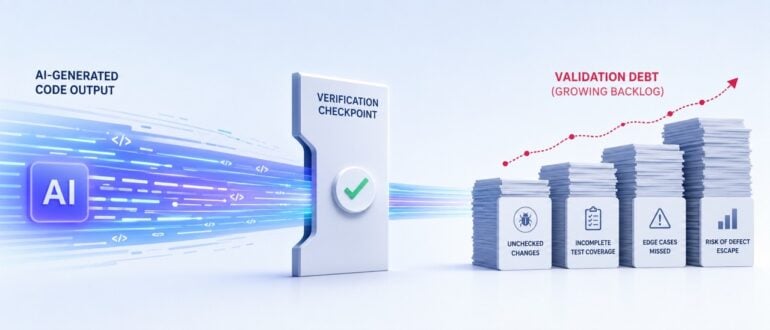

The gap between how fast AI writes code and how reliably teams verify it is quietly becoming a balance-sheet risk. Enterprise leaders are learning to measure it before it forces repayment.
Every engineering organization that adopted AI coding assistants over the past two years has quietly taken on a liability that never appears on the dashboards leadership actually reviews. Developers now generate more code than their teams can meaningfully verify, and the gap between the two compounds on every passing build until an incident forces the account to settle.
The cost tends to land late and all at once, usually as an outage or a failed audit that traces back to a change nobody fully checked. For the executives who answer for delivery risk, the trouble is not the tooling their engineers reach for but the plain fact that verification capacity never scaled to match the new pace of output.
The Liability That Never Reaches the Dashboard
Leadership reporting evolved to track the things that have always mattered, delivery speed, defect counts, and uptime, and none of it shows how much unverified code a team ships in a given week. That blind spot is where validation debt takes hold, because a risk that never surfaces in the numbers is a risk leadership never thinks to question.
Mudit Singh, Co-Founder and Head of Growth at TestMU AI (formerly LambdaTest), sees this pattern repeat across the enterprise engineering teams he meets on the company’s customer events. He observes that output jumps the moment a team adopts AI assistance while verification stays flat, and leaders rarely register the widening gap until something breaks, because nothing in their regular reporting makes the debt visible. What the team learned building KaneAI, the company’s testing agent, is that the shortfall is almost never about talent and almost always about visibility, since engineers can only guard against risks they can actually see.
The broader argument Mudit presses is organizational rather than technical, because someone has to own validation coverage as a named responsibility instead of letting it spread thinly across a busy team. His recommendation for leaders is to track test escape rate as a reporting number they watch directly and to treat AI-generated changes as their own visible category, since once a leader assigns that ownership the conversation moves from whether the debt exists to how fast the organization intends to bring it down.
Evidence Becomes the Standard in Regulated Work
In regulated industries the cost of an unverified change is not measured in a quick hotfix but in an audit finding that can surface months after the code shipped. A passing test suite offers little protection when the real question is whether anyone can prove, long after the fact, that the team ever checked the behavior that mattered.
Karthik Karunanithi, a Solution Architect at IBM and a Senior Member of IEEE with two granted United States patents in secure health data, works in exactly those settings, where a passing build has never counted as proof of much. An AI-assisted change to an authorization path once shipped with tests that mocked the very layer they should have tested, and the gap surfaced only in the audit logs, when a query ran that policy should have stopped cold. Karunanithi responded by requiring every AI-assisted change to leave behind enough evidence for another engineer to see what the tests exercised and reproduce the result later.
The principle Karunanithi keeps returning to is that a green build tells him the pipeline ran and nothing more, so evidence rather than appearance has to become the standard the moment a missed check carries real cost. Teams that adopt his posture stop asking whether the build passed and start asking what the passing build genuinely proves, which quietly changes how they treat any code they did not write by hand.
Human Review Cannot Scale on a Curve
The instinct when pull request volume explodes is to ask reviewers to work harder, yet no amount of effort closes a gap that is structural rather than personal. A person can read only so much code in a day, and that ceiling does not lift just because a machine started writing several times as much.
Abhilash Rao Mesala, a Senior Data Engineer at Meta with fourteen years across healthcare and enterprise systems, watched that ceiling turn into a quality problem in plain sight. On his teams the volume of AI-assisted pull requests climbed until human review could no longer keep pace, and reviewers started approving changes more shallowly even though everyone understood the depth had slipped while the builds stayed green. His group answered by routing low-risk changes to an automated reviewer inside a fixed threshold and reserving scarce human judgment for the changes that carry real consequence.
The framing Mesala offers leaders is deliberately structural, because review capacity grows in a straight line while AI output grows on a curve, and no hiring plan closes that shape of gap. He measures post-merge defects by approval type so leadership gets a clean read on whether the balance between speed and safety is holding, and the same threshold quietly discourages the sprawling changes that tend to hide the most risk.
Agentic Systems Raise the Interest Rate
Everything gets harder the moment the software stops waiting for a human to press each key and starts planning its own steps. An agent that chooses a different path on every run breaks the last comfortable assumption traditional testing rested on, which is that the same input reliably produces the same output.
Ahmed Zaidi, CEO and Managing Partner at Accelirate, sees the stakes climbing as enterprises move from AI-assisted code into fully agentic systems that act without a human keying each step. Zaidi points out that validation debt compounds faster once behavior stops being deterministic, because a single passing test proves even less than it did before when the system can behave differently the next time it runs.
The recommendation Zaidi lands on for leaders deploying agents is to treat validation as a continuous practice rather than a one-time gate, re-checking behavior on every meaningful change to the prompt, the model, or the data the agent leans on. No one can check a
shifting system a single time and then trust it to behave forever, so validation has to run as often as the system itself changes.
Making the Debt Visible and Payable
Validation debt behaves like any other liability a business carries, which means it stays manageable only when someone measures it, assigns it, and decides how fast to bring it down. The organizations getting ahead of it are not slowing their engineers or backing away from AI assistance in the slightest.
Mudit Singh of TestMU returns to the discipline he opened with, urging leaders to hold every change to the same gates no matter who or what wrote it and to watch defect escape into production as the figure that tells the truth about their exposure. His closing point for executives is that generation will only accelerate from here, so the teams that fund verification as a first-class capability are the ones that keep shipping fast without quietly borrowing against their own reliability.