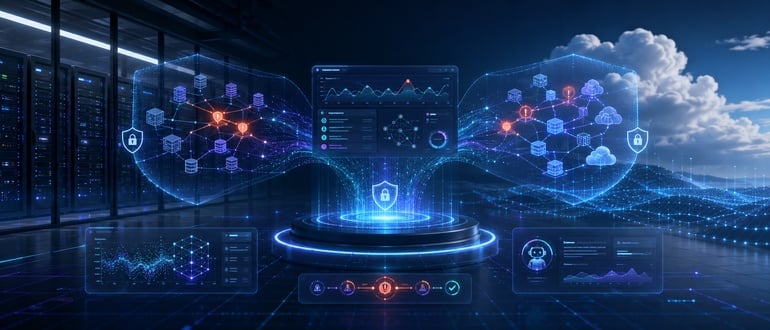

ManageEngine OpManager Nexus enhanced its newly launched hybrid observability platform with a range of powerful AIOps capabilities. OpManager Nexus was launched in April 2026 with the merger of two of ManageEngine’s flagship observability solutions: OpManager Plus and Site24x7. The new platform is unique in the observability market with its dual deployment strategy: You can either install it on-premises, or access it via the cloud.
AIOps (artificial intelligence in IT operations) has now become a non-negotiable in the observability platform market. This is not surprising given the effectiveness of AI in managing the vast and complex telemetry data that modern IT architectures generate. OpManager Nexus now ships MCP server support, GenAI integrations, autonomous AI agents, and smart event correlation, all under one roof.
What makes OpManager Nexus different from its competitors isn’t just the feature list. It’s how the platform handles the question every ITOps team is quietly asking right now: when AI is running inside your monitoring stack, where does your data actually go?
We’ll get to that. First, let’s look at what’s new.
Unify Tool Stacks With MCP Servers
MCP (Model Context Protocol) is Anthropic’s open-source standard for connecting AI tools to external platforms. It’s been around since November 2024, and adoption has been steep: Monthly downloads have crossed 110 million. The reason isn’t hard to figure out. Before MCP, integrating IT operations in your tool stack meant writing custom integrations for every tool. MCP cuts through that.
OpManager Nexus now ships with its own MCP server. Once connected to an MCP client like: Cursor, Visual Studio Code, Claude Desktop, or Windsurf, your AI assistant can pull live metrics, find anomalies, and correlate observability data with the other tools in your stack: version control, CI/CD pipelines, helpdesk tools, you name it.
What does that look like in practice? You can ask your AI assistant to show you servers with high CPU usage over the last two hours and get an answer from live data. During an outage, AI can suggest the next checks: logs, memory spikes, latency. You can also correlate helpdesk tickets with observability metrics and deployment milestones, so incidents get traced back to what actually caused them.
Deployment follows the same dual-track model as OpManager Nexus itself. On-premises teams get the MCP server as a Docker image that runs locally. Cloud customers get it hosted inside Zoho’s private datacenters.
Enable Autonomous AI-Driven Monitoring With Zia Agents
On the cloud side, OpManager Nexus also introduced agentic AI powered by Zia, Zoho’s proprietary AI engine. This is a shift from reactive firefighting to autonomous ITOps.
Modern IT environments don’t fail neatly. A single incident in a distributed system can generate thousands of signals across hybrid clouds, microservices, and dynamic networks simultaneously. When that happens, troubleshooting becomes guesswork. Teams end up chasing symptoms instead of root causes, and MTTR climbs.
Zia’s autonomous agents are designed to cut through that. The key capabilities: domain-aware causal correlation paired with predictive anomaly detection, customizable AI agents with governed task-driven automation, an MCP-enabled agentic foundation, and orchestrated remediation that plugs into existing workflow platforms.
Tune Out the Alert Noise With Smart Event Correlation
Here’s the reality most ITOps teams deal with: observability platforms fire alerts for every event that crosses a threshold. In a complex environment, a single incident can trigger hundreds of them.
OpManager Nexus tackles this with AI-powered event correlation. Instead of dumping a flood of disconnected alerts on your team, it groups related events into a single structured problem. Zia traces the full chain of events across your stack to separate root-causes from symptoms, so your team knows exactly where to start.
The practical benefit? Your engineers spend less time triaging and more time fixing. And they fix the right thing.
Get Real-Time, Accurate IT Insights With GenAI Integrations
Raw telemetry is only valuable if your team can interpret it fast. OpManager Nexus ships with three GenAI integrations: OpenAI, DeepSeek, and Ollama. Each doing something slightly different.
OpenAI and DeepSeek work similarly: connect via API key and you get AI-generated summaries across device health, active alarms, and performance metrics. Teams can pull a consolidated alarm overview, drill into individual alarms with probable causes and recommended fixes, or get a snapshot of device group health. Both integrations also support script generation. Describe what you want to monitor in plain language, and the AI produces the script, whether that’s PowerShell, Python, Shell, or something else.
Ollama is the one for teams with strict compliance regulations. It runs entirely within your environment. No external API call is ever made. Local LLMs handle all the processing, which means your infrastructure data never leaves your perimeter. The default model is gpt-oss:20b, but teams can swap in any model they’ve downloaded.
On the cloud side, Zia finds all of this through a natural language interface. Beyond summaries, Zia supports cross-monitor RCA comparison, recurring issue detection, error code analysis, and seasonal pattern analysis to cut down on false positives.
AI-Sovereignty in OpManager Nexus
AI sovereignty is the practice of retaining full control over how your organization’s data is processed, stored, and used by AI systems. For IT teams, this means ensuring that observability data (often containing sensitive infrastructure details) never leaves your control without explicit governance. As AI becomes embroiled in IT operations, sovereignty isn’t just a compliance checkbox. It’s a foundational requirement for any organization serious about NetSecOps.
ManageEngine and its parent company Zoho have taken a privacy-first position on AI, and OpManager Nexus reflects that at the architecture level.
Zoho’s secure datacenters: OpManager Nexus’ cloud version hosts all data, including its MCP server, inside Zoho’s private datacenters. Your observability data stays within Zoho’s privacy-focused cloud stack, never routed through third-party infrastructure.
On-premise hosted MCP functionalities: For teams that require full on-premises control, OpManager Nexus distributes its MCP server as a Docker image that runs locally. All communication between MCP clients and your OpManager Nexus instance stays entirely within your environment.
Built-in Zia engine: Zia is Zoho’s proprietary AI, built natively into OpManager Nexus. Unlike third-party AI bolt-ons, Zia processes your observability data within Zoho’s governed infrastructure, keeping AI-driven insights under your organizational control.
Ollama integration: Ollama runs local language models entirely within your perimeter. No external API calls, no data leaving your environment. OpManager Nexus on-premises integration with Ollama is hosted locally. This makes it the definitive choice for teams with strict data residency requirements or air-gapped deployments.
The result is a platform where every AI capability has a path that doesn’t require shipping sensitive data somewhere you don’t control.
Bottom Line
The next wave of observability isn’t just about collecting more telemetry, it’s about getting AI to act on it intelligently, quickly, and securely. OpManager Nexus’ MCP server, Zia agents, event correlation, and GenAI integrations each tackle a different piece of that problem. With built-in AI sovereignty, you can stop worrying about data leakage concerns and focus on running your ITOps.
Whether you’re running on-premises or in the cloud, there’s a 30-day free trial if you want to see how it stacks up in your environment.