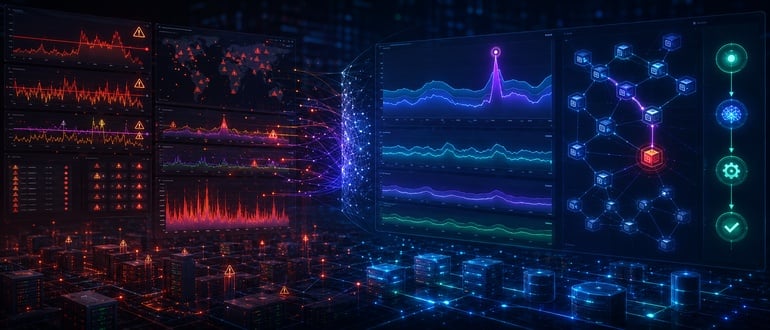

A static alert at 80% CPU or a two-second response time threshold is an absolute judgment applied to a system that operates in relative terms. However, traffic patterns shift by hour, day, and season. Deployments alter performance baselines. External dependencies introduce latency profiles that no team fully controls. A fixed number stops being a reliable signal the moment conditions drift from when they were configured, and in production, conditions drift continuously.
The result is a detection gap that most IT teams know intimately. The alert fires, the incident channel opens, and somewhere upstream a user has already filed a support ticket. AI-driven application performance monitoring (APM) addresses this by shifting from fixed judgment to continuous inference. ML models establish behavioral baselines for every monitored signal, accounting for seasonality, deployments, traffic patterns, and surface deviations as they emerge rather than after they have crossed a threshold set months ago.
Why Static Thresholds Fail at Scale
Static thresholds measure absolute values rather than meaningful change. A web application serving 5,000 requests per minute on a Tuesday afternoon is healthy. The same number during a quiet weekend window may represent a significant anomaly. A static threshold cannot distinguish between them because it has no concept of expected behavior.
In distributed systems, the problem compounds further. A latency spike in one service may produce error rate increases downstream 30 seconds later. A connection pool approaching saturation may generate P99 increases that are individually below threshold but collectively indicative of an impending outage. IT teams end up with either excessive noise from thresholds set too sensitively, or blind spots from ones set too conservatively. Either way, alert fatigue sets in and critical notifications get discounted alongside the routine ones.
What ML Changes About Detection
ML models evaluate a metric against a probabilistic model of what it should look like given the current time, traffic volume, deployment history, and seasonal patterns. An anomaly is not a value that exceeded a threshold but a value that is statistically inconsistent with established baseline behavior. A checkout latency of 1,800ms may be normal during a peak traffic window following a promotional campaign. However, the same value at baseline traffic with no recent deployments is a genuine signal.
The model doesn’t evaluate whether a metric is high, instead it judges whether it is behaving differently than it should—a distinction with considerably higher diagnostic precision. It suppresses routine fluctuations that pollute threshold alerting while surfacing the statistically meaningful deviations that precede user-impacting incidents. A model aware of day-of-week patterns will not alert on the predictable Monday morning spike that has occurred every week for a year, but will alert when that spike arrives 40% larger than historical norms suggest.
From Detection to Diagnosis
Early detection is only the first part of the problem. In systems with hundreds of services, determining what changed and why can consume more time than the fix itself. Causal AI addresses this by determining not just which metrics changed, but which changed first and which are downstream consequences. A memory leak in a connection pool may produce correlated increases in response time, error rate, and query latency across multiple services. Simple correlation surfaces all of them; causal analysis identifies the origin and directs the investigation there. Now, engineers arrive with a prioritized hypothesis rather than an open-ended list of affected components.
OpManager Nexus illustrates this approach through its Zia AI engine, which applies robust principal component analysis (RPCA) and matrix sketching algorithms to identify deviations against seasonally benchmarked values. Domain-aware ML then correlates related alerts within a 10-minute window into a single consolidated problem, so teams receive one actionable notification with clear context rather than hundreds of individual alerts for the same incident.
From Diagnosis to Autonomous Action
Identifying the root cause is not the end of the incident workflow. Once a problem is understood it still needs to be acted on, and that action carries its own risk in complex environments. Runbooks get skipped under pressure. Remediation steps vary between engineers. However, the same causal intelligence that locates a problem can also drive consistent, governed response.
The emerging model is AI agents: purpose-built automations that operate within defined guardrails, follow approved solution documents, and execute remediation tasks without requiring an engineer to drive each step manually. The governance layer matters as much as the automation itself.
The MCP has emerged as a structural approach here, providing a standardized interface through which agents access observability data, reference approved guidance, and execute tasks within enterprise-defined controls. OpManager Nexus’ recent additions in this space include customizable AI agents with configurable guardrails, MCP-based agentic workflows, and orchestrated remediation through structured runbooks with approvals and traceability built in. The result moves incident response from a sequence of manual steps toward a governed, repeatable workflow that behaves consistently regardless of who is on call.
What This Means for DevOps Teams
The practical implication for on-call engineers is a change in how investigation begins and how resolution proceeds. Without AI-driven monitoring, the alert fires and the engineer examines dashboards, forms hypotheses, and tests them sequentially until the root cause surfaces, a process that can take 30 minutes to several hours. With causal AI the alert fires earlier and arrives with a diagnosis, and with agentic workflows the first remediation steps may already be underway before the engineer opens a terminal.
Mean time to recovery (MTTR) is the metric this affects most directly. Early customers have reported filtering out close to 90% of alert noise while significantly improving SLA adherence. Earlier detection, faster diagnosis, and governed automated response compound into a structural change in how IT operations handles failure, not an incremental one.
The shift is not automatic, as ML models require sufficient historical data and agents require careful scoping to operate safely in production. But the direction is clear. The question is no longer whether AI belongs in APM but how far into the incident life cycle it should reach.