

Traditional software deployments are high-risk, all-or-nothing events. A single faulty release configuration can cascade into outages, increased error rates, customer impact and costly rollbacks. Progressive delivery changes this paradigm by introducing controlled, observable and reversible releases. The traditional ‘big bang’ release — where code is merged and deployed at 2:00 a.m. — is increasingly a relic of the past.
‘Progressive delivery’ is the modern evolution of continuous delivery, designed to reduce the blast radius of new features and decouple ‘deployment’ (moving code to production) from ‘release’ (exposing features to users).
In a progressive-delivery model, the goal is to move from a binary state (on/off) to a spectrum of availability. This is achieved through two primary pillars:
- Release Observation: Monitoring the health of a deployment in real-time.
- Release Control: Using technical levers to shift traffic or toggle features without redeploying code.
Instead of: ‘Deploy and Pray’, Move to: ‘Deploy, Observe, Decide and Expand’
Key Strategies for Risk Mitigation
To deploy without fear, organizations typically employ one or more of the following patterns:
- Feature Flags: Wrapping code in conditional logic to turn features on/off remotely. Performed using dark launching, A/B testing and emergency ‘kill switches’.
- Canary Releases: Routing new code to a small percentage (e.g., 1% or 5%) of traffic. Detecting regressions or performance bottlenecks early in routed users.
- Blue/Green Deployment: Maintaining two identical environments; one is live, one is idle/backup. Zero-downtime cutovers and instant rollbacks to backup version.
- Shadowing: Mirroring live traffic to a new service without sending the response to the user. Load testing and validating data accuracy under real stress.
The Automation Feedback Loop
Deployment fear usually stems from the uncertainty of new code exposure, mismatched config, logic misalignment but largely by untracked code changes. Progressive delivery eliminates this by automating the ‘promotion’ and ‘rollback’ phases based on service level indicators (SLIs).
For example, a typical automated workflow might look like this:
- Deploy to a small subset of nodes.
- Analyze error rates and latency.
- Check Condition: If error rate <0.1% and latency_p99 <200 ms, then increase traffic.
- Auto-Rollback: If metrics exceed thresholds, the system automatically flips the traffic back to the stable version
Progressive Delivery Cultural Shifts
Technical tools alone won’t solve ‘deployment anxiety’. Progressive delivery requires a shift in how teams view failure:
- Decoupling Deploy From Release: Engineers can deploy code on Tuesday morning, but product managers release the feature on Thursday when marketing is ready.
- Observability Over Monitoring: Moving beyond “Is the server up?” to “Is the user’s experience degraded?”
- Small, Frequent Batches: Reducing the size of a change makes it exponentially easier to debug if something goes wrong.
What This Means for Modern DevOps
Progressive delivery isn’t just a deployment technique; it fundamentally reshapes the role, responsibilities and mindset of DevOps teams. Instead of being gatekeepers of releases, DevOps evolves into enablers of safe, continuous experimentation at scale.
DevOps can now add ‘a layer of observability’ and adapt to changed releases.
Build → Test → Deploy → Observe → Decide → Adapt
What Changes
CI/CD integrates with observability systems. Deployment success is ‘metric-driven’, not just completed. Rollouts become ‘progressive and conditional’.
Automation Over Manual Intervention: Manual approval slows down delivery and introduces inconsistency. Instead of developing team managing releases, DevOps and SRE’s can take the processes in hand proactively.
- DevOps Owns Feature Release Strategy
Impact
- Developers Ship Code Anytime
- DevOps Controls When and How Users See It
Infrastructure as Experimentation Platform: Infrastructure is no longer static — it has become a dynamic experimentation layer.
DevOps enables:
- A/B Testing at Scale
- Gradual Feature Exposure
- Region-Based Rollouts
Risk Management Becomes Proactive: Instead of reacting to incidents, DevOps actively reduces risk before full impact.
- New Approach
- Small Blast Radius Deployments
- Early Anomaly Detection
- Continuous Validation
Metrics of Success Change
Old Metrics
- Deployment Success Rate
- Uptime
New Metrics
- Change Failure Rate
- Mean Time to Recover (MTTR)
- Rollback Frequency
- Release Observability
Integrating Agentic Ops With Progressive Delivery
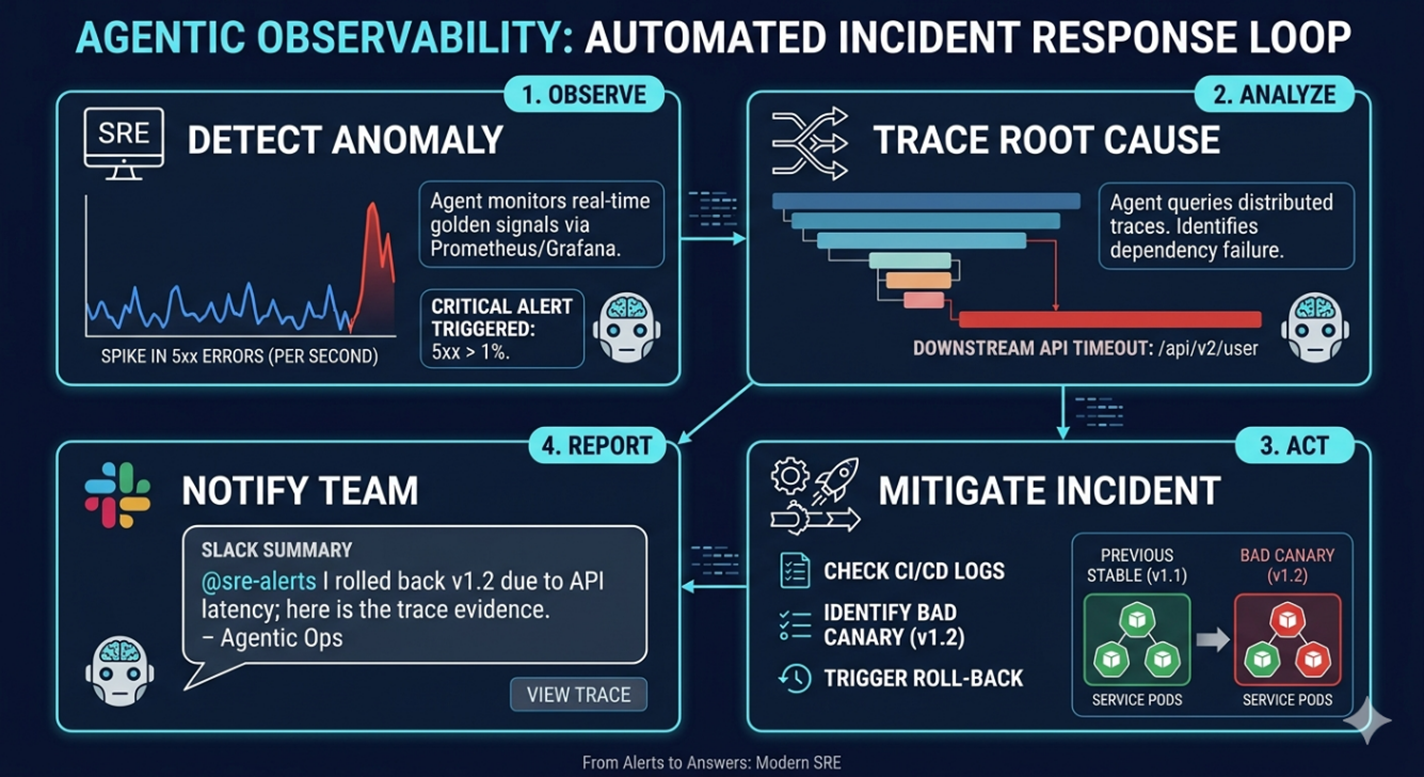
Progressive delivery (canary, blue-green, feature flags) minimizes risk during deployments — but still relies heavily on human monitoring and decision-making. Agentic Ops introduces intelligent agents that can observe, analyze and act in real-time. It helps to combine both to create self-evaluating, self-healing deployment systems that can automatically promote, pause or roll back releases based on live system behavior.
Architecture With Agentic Ops
- Observe (Telemetry Layer): Monitor metrics such as latency, error rate, saturation, logs + traces for deep debugging and business KPIs (conversion, drop-offs). Agents continuously monitor deployment health before, during and after progressive deployment.
- Analyze (Decision Engine/Agent Brain): Compare against SLOs and baselines, detect anomalies (spikes, regressions) and correlate issues with recent deployment. Analyze historical patterns, recover and prepare a postmortem recovery report. For example:
- Error rate increased by 12% after canary rollout.
- Latency regression tied to new API version.
- Act (Progressive Delivery Controls): Agent triggers a pause, rolls back the deployment, promotes the canary to a full release and adjusts traffic weights dynamically.
- Report (Explainability Layer): Slack/dashboard updates, RCA summaries, evidence-backed decisions, builds trust in autonomous systems.
Advanced Patterns With Progressive Delivery
1. Adaptive Canary
Agent dynamically adjusts traffic based on real-time health.
5% → 10% → 25% → 50% → 100%
2. Multi-Metric Decisioning
Instead of just error rate, combine latency, errors and business KPIs.
3. Predictive Rollbacks
Agent rolls back before user impact escalates.
4. Learning Systems
Agents improve overtime with past incidents, deployment history and failure patterns.
Key Challenges to Watch For
Non-Determinism: Unlike code, an agent might pass a canary test once and fail it the second time. You need multiple runs per canary stage to gain statistical confidence.
Stateful Memory: If an agent learns or has a memory store, a rollback is harder. You must ensure your progressive delivery strategy includes vector database versioning.