
Digital transformation has never been short of ambition. Enterprises have invested billions in AI initiatives, cloud migrations, agile programs, and customer success platforms—yet many still find themselves stuck: Pilots that never scale, software that sits unused, teams that move fast in isolation but grind to a halt when they collide. The question isn’t whether organizations want to transform. It’s whether they know how to make value actually flow.
That question sits at the heart of conversations happening across the world’s most complex organizations. From aerospace and defense to aviation, industrial software to telecom infrastructure, leaders are learning the same hard lesson: Transformation is less a technology problem than a systems problem — and solving it requires aligning people, process, and platforms around the uninterrupted movement of value.
Scaling AI Beyond the Proof of Concept
For many enterprises, AI is still a pilot program. A promising prototype here, a promising use case there—but the operational scale that would actually move the needle remains elusive. Brian Moore, a leader at RTX (Raytheon Technologies), one of the world’s largest aerospace and defense firms, has seen this pattern up close and believes the answer lies in physics as much as it does in technology.
Drawing on Industrial DevOps, SAFe, and the constructal law—a principle from physics that describes how flow systems evolve to move things more efficiently—Moore argues that enterprises must architect their AI deployments the way nature architects rivers: with channels deliberately designed to reduce resistance and maximize throughput.
“Realizing the promise of AI in an enterprise requires moving beyond pilots to large-scale deployments, guided by principles derived from the constructal law of physics,” says Moore. “The practices of Industrial DevOps and SAFe align with constructal theory and give us direct guidance on how to rapidly scale AI benefits—and the case studies from RTX prove it’s possible.”
The lesson: Flow isn’t accidental. It has to be engineered.
When Adoption Isn’t Enough
Even where software is deployed at scale, value doesn’t automatically follow. Giso van der Heide, a customer success strategist at Siemens, points to a startling statistic: An estimated 46% of enterprise applications remain underutilized or unused, representing billions of dollars in wasted licenses every year. The culprit, he argues, isn’t bad software — it’s the wrong success metric.
Van der Heide’s concept of Outcome Engineering reframes customer success entirely. Rather than measuring whether users log in, it asks whether they are achieving the specific business outcomes the software was purchased to deliver. His Persona Outcome Fabric maps the Jobs to Be Done for individual user roles and connects them directly to quantified performance measures and ROI—bridging the gap between a product’s features and the measurable value a business actually needs.
AI plays a central role in this model, helping generate customized adoption roadmaps and persona-specific success plans at a scale no human team could manage manually.
“Adoption without clear business impact is merely noise,” says van der Heide. “True customer success requires a structured methodology that measures tactical KPIs alongside actual business impact—and AI-driven components are what make that personalization scalable.”
The Friction at the Intersections
Scaling individual value streams is challenging enough. But as Ja’Mesa Dixon, a flow and agility practitioner at Zayo Group, will tell you, the real complexity begins when those streams start to interact. Shared platforms, competing funding priorities, cross-team dependencies — these intersections are where organizational momentum goes to die.
Dixon’s work helping enterprises evolve from team-level agility to system-level flow has given her an unflinching view of what actually breaks down and what actually helps. Her insight: the solution isn’t heavier governance. It’s smarter coordination — lightweight mechanisms that resolve dependencies without creating bureaucratic drag, and enough psychological safety for teams to surface problems before they compound.
Critically, Dixon emphasizes that Value Stream Networks are as much a human challenge as a structural one. Progress is rarely linear, and leadership’s appetite for speed must be balanced with the reality that trust is built through small, visible wins over time.
“Success in Value Stream Networks isn’t just about frameworks,” says Dixon. “It’s about meeting people where they are, managing the friction at the intersections, and building momentum through visible progress — not above it, but right in the middle of it.”
Transformation is a People Problem
Nowhere is the human dimension of transformation more visible than in talent strategy. TaQuonda Hill, who has led Delta Air Lines’ largest cloud migration and workforce enablement initiatives, has built a blueprint for what she calls a product-centric Cloud Target Operating Model—a framework that treats people, process, and technology as a single integrated system rather than parallel workstreams.
Her experience at Delta underscores a truth that too many transformation programs overlook: Agility at scale requires not just restructured processes but re-energized people. Talent empowerment, inclusive design, and continuous learning aren’t soft add-ons to a technical program—they are the operating conditions that make everything else work.
“True transformation lies at the intersection of technology, people, and process,” says Hill. “Visionary leadership has to translate enterprise strategy into tangible value by aligning technology enablement with people-centric design—and that means building a resilient, future-ready workforce, not just deploying new tools.”
The Common Thread: Flow
What connects Brian Moore’s physics-inspired AI scaling model, Giso van der Heide’s outcome engineering framework, Ja’Mesa Dixon’s Value Stream Network field notes, and TaQuonda Hill’s talent transformation blueprint? All four are, at their core, about the same thing: Removing the barriers that prevent value from moving through an organization — from strategy to execution, from technology to people, from pilot to production.
Flow is not a buzzword. It is a discipline. And the enterprises that master it will be the ones that turn transformation ambition into transformation results.
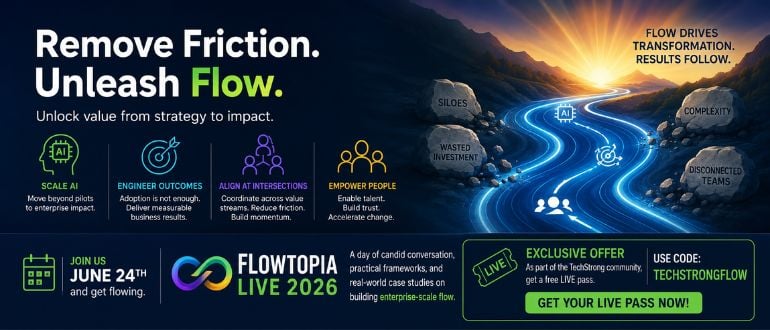
Hear Brian Moore, Giso van der Heide, Ja’Mesa Dixon, TaQuonda Hill, and many more at Flowtopia Live. Join leaders from across the industry for a day of candid conversation, practical frameworks, and real-world case studies on building enterprise-scale flow.
Join us on June 24th and get flowing.
Exclusive Offer: As part of the TechStrong community, get a free LIVE pass.
Use Code: TECHSTRONGFLOW
Get your Live Pass to Flowtopia Live 2026 here.