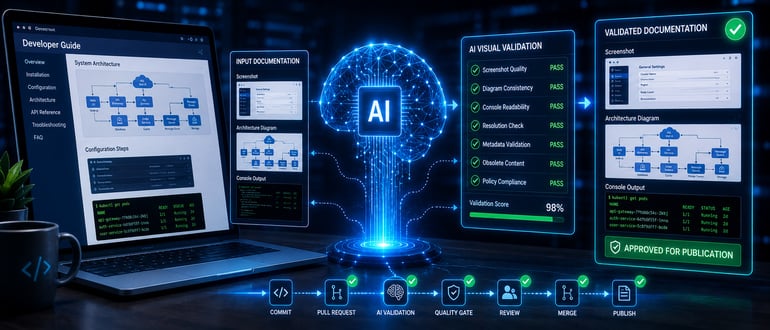

Every release changes documentation alongside the code. Developers depend on that documentation during implementation, maintenance and troubleshooting. A diagram becomes misleading once services are renamed or integrations change without a corresponding documentation update.
Keeping documentation updated becomes increasingly difficult as repositories, products and release cycles grow. Outdated or inconsistent images eventually find their way into published documentation.
Predictive AI automates visual validation before publication, enforcing documentation standards and identifying issues early. This helps engineering teams maintain reliable, consistent and scalable knowledge bases.
Why Visual Documentation Quality Matters for Developer Experience
Developers rely on documentation that accurately reflects software behavior and system architecture. Engineers use screenshots, architecture diagrams and console captures to verify configurations, understand system relationships and troubleshoot issues. They spend less time validating documentation when visual assets remain accurate and consistent.
Outdated screenshots, inconsistent diagrams and unreadable console outputs introduce implementation errors, configuration inconsistencies and longer troubleshooting cycles. Engineers spend less time validating documentation when visual assets remain accurate and consistent.
Effective visual documentation supports:
- Screenshots: Capture interface states and configuration workflows that developers can reliably follow.
- Architecture Diagrams: Explain service relationships and data flows to support system analysis and change planning.
- Console Captures: Preserve execution outputs and error messages for troubleshooting and operational verification.
- Standardized Visual Formatting: Maintains consistent layouts, annotations, metadata and image quality across documentation repositories.
- Consistent Visual References: Accelerate onboarding by reducing knowledge gaps during implementation.
- Shared Documentation Standards: Development, DevOps, QA and technical writing teams work from consistent documentation throughout the software life cycle.
Documentation remains easier to maintain as engineering teams work from the same standards across repositories and releases.
Common Visual Documentation Challenges in Modern Engineering Teams
Engineering documentation changes continuously as software architectures, interfaces and deployment processes evolve. Without standardized validation, documentation quality becomes increasingly difficult to maintain across software releases, reducing reliability and increasing maintenance effort across engineering repositories and knowledge platforms.
Low-Resolution Screenshots and Unreadable Console Logs
- Low-Resolution Screenshots: Obscure interface elements, configuration values and navigation steps.
- Compressed Images: Reduce text readability, preventing engineers from validating configuration values and command syntax.
- Unreadable Console Captures: Hide command outputs, error messages and execution results required for troubleshooting.
- Cropped Screenshots: Remove the technical context needed to reproduce issues and verify implementation steps.
As these issues accumulate across documentation repositories, engineers spend more time validating information, troubleshooting inconsistencies and maintaining documentation instead of delivering software.
Documentation Drift Across Developer Portals and Internal Wikis
Documentation drift occurs when visual assets are updated inconsistently across repositories, internal wikis and developer portals. Common issues include:
How Predictive AI Improves Documentation Quality
Manual visual reviews become difficult as documentation expands across repositories, products and release cycles. As verification bottlenecks in AI workflows continue to grow, automated documentation validation becomes essential. Predictive AI shifts validation from manual inspection to automated quality checks, helping engineering teams identify visual defects early and prevent invalid assets from reaching production knowledge bases.
Detecting Visual Quality Issues Before Publication
Instead of reviewing every image manually, AI models evaluate visual assets against predefined quality rules during documentation builds or pull request validation.
- Screenshot Verification
- Detects incomplete screenshots
- Identifies cropped images
- Flags outdated screenshots before publication
- Diagram Validation
- Identifies missing labels
- Detects inconsistent annotations
- Highlights structural differences between diagram versions
- Console Output Validation
- Detects unreadable command outputs
- Identifies truncated error messages
- Policy Enforcement
- Rejects documentation assets that fail predefined quality standards
Using OCR and Computer Vision to Validate Technical Images
OCR extracts machine-readable text from screenshots and console captures. Computer vision evaluates image quality, structure and visual similarity without manual review.
Building an Automated AI Pipeline for Visual Documentation
An automated AI pipeline validates visual documentation before publication, reducing dependence on manual review. Automated validation becomes essential when documentation spans multiple repositories, products or engineering teams.
Collecting and Assessing Visual Assets
The pipeline collects visual assets into a centralized validation workflow. During documentation builds or pre-publication reviews, AI evaluates readability, duplication, resolution and policy compliance.
Below are some common documentation sources.
- Git Repositories: Architecture diagrams, pie charts, README images, workflow illustrations and release documentation.
- Internal Wikis: Technical guides, operational runbooks, troubleshooting procedures and engineering knowledge articles.
- Developer Portals: API documentation, onboarding guides, implementation tutorials, product documentation and developer avatars used in technical profiles.
- Documentation Platforms: Product manuals, technical publications and centralized knowledge bases.
Cleaning and Standardizing Visual Documentation
Approved assets are standardized before publication to maintain consistency across documentation sources. The process includes:
- Restoring blurry screenshots with an AI image unblur tool and improving legacy diagrams
- Standardizing image resolution, annotations, metadata and naming conventions
- Removing duplicate and obsolete visual assets
- Replacing outdated screenshots with validated versions that reflect the current software release
The pipeline publishes only approved assets, ensuring documentation remains consistent, maintainable and ready for engineering teams to use.
Integrating Documentation Quality Gates Into DevOps Workflows
Documentation quality gates extend automated validation into the software delivery pipeline. Instead of reviewing documentation after release, engineering teams validate visual assets during development and deployment, especially when documentation spans multiple repositories, products or engineering teams. As AI is transforming DevOps and cloud engineering, organizations can apply the same automation principles to documentation quality, integrating visual validation into CI/CD workflows.
Documentation Validation in CI/CD Pipelines
Documentation validation should run alongside code quality checks during CI/CD workflows, preventing invalid documentation from progressing through the delivery pipeline.
- Validation activities typically include:
- Verifying screenshot readability, image resolution and visual clarity
- Validating architecture diagrams against documentation policies
- Detecting duplicate, outdated or missing visual assets
- Confirming metadata, annotations and naming conventions
Continuous Documentation Reviews With Git-Based Workflows
Git-based workflows automatically validate documentation whenever changes are committed or submitted for review before merge approval.
Continuous review practices include:
- Pull Request Validation: Review modified screenshots, diagrams and documentation assets before merge approval.
- Automated Documentation Checks: Execute AI validation during commits and pipeline execution.
Together, CI/CD quality gates and Git-based reviews keep documentation synchronized with software changes and prevent inconsistent visual assets from reaching production knowledge bases.
Best Practices for AI-Assisted Visual Knowledge Bases
AI-assisted visual knowledge bases require consistent governance to maintain documentation quality across multiple repositories, products and engineering teams.
Step 1: Define Documentation Quality Standards
Define documentation standards before integrating AI validation into engineering workflows, and apply them consistently across Git repositories, developer portals, internal wikis and documentation platforms.
Establish standards for:
- Image resolution and readability
- Diagram annotations and labeling
- Metadata and naming conventions
- Version control and document ownership
- Documentation approval criteria
Step 2: Combine AI Validation With Human Review
Use AI for repeatable validation tasks throughout the documentation life cycle. Reserve human review for technical decisions that require engineering judgment.
Configure AI to validate:
- Screenshot quality and resolution
- Diagram consistency
- Duplicate visual assets
- Metadata compliance
- Documentation policy violations
- Assign human reviewers to verify:
- Technical accuracy
- Architecture modifications
- Implementation procedures
- Release-specific documentation
Step 3: Measure Documentation Quality Using Operational KPIs
Use each release to assess documentation quality, identify recurring issues and strengthen validation standards.
Track metrics such as:
- Documentation validation pass rate
- Duplicate asset count
- Outdated image frequency
- Documentation review time
- Publishing success rate
- Documentation defect reports
Key Takeaways
- Standardized visual documentation gives developers a reliable reference for implementation, onboarding and technical collaboration.
- Predictive AI identifies documentation issues before publication, reducing manual review effort and documentation drift.
- AI pipelines standardize documentation workflows and maintain consistent visual assets across engineering environments.
- Documentation quality gates integrated into CI/CD pipelines prevent invalid visual assets from reaching production knowledge bases.
- Long-term documentation quality depends on governance, human review and continuous measurement through operational KPIs.