

Most developers use AI for system design in the weakest possible way: They ask one model for one architecture.
That is useful, but incomplete.
Real system design is not a single answer. It is a negotiation between scalability, cost, reliability, security, delivery speed, operational complexity and team capability. A good architect does not just propose a design. They defend it, attack it, simplify it and document why it prevails.
This is where agentic multi-model design becomes powerful.
Instead of asking Claude, Codex, GPT or any single model to “design a system,” we can automate a workflow where multiple AI agents debate the architecture and converge on the most practical design.
The result is not a chatbot answer. It is an automated architecture review board.
The Core Idea
The workflow is simple:
- One model proposes the design.
- Another model critiques it.
- Another model evaluates implementation complexity.
- Another model scores tradeoffs.
- A final orchestrator forces convergence into a decision record.
This turns AI from a design assistant into an agentic system design pipeline.
The important part is not which model is ‘best’. The important part is role separation.
A single model tends to optimize for a polished answer. Multiple agents optimize for tension. Tension is where better architecture comes from.
The Agent Roles
A strong automated design workflow needs at least five agents.
Requirement Clarifier Agent
This agent converts a vague idea into an engineering brief.
Input: Build a scalable B2B order processing system.
Output:
- Users and actors
- Traffic assumptions
- Latency goals
- Availability target
- Consistency requirements
- Compliance constraints
- Existing systems
- Non-goals
- Unknowns
This prevents the rest of the pipeline from designing around assumptions nobody agreed to.
Architect Agent
An architect agent creates the first complete proposal.
It defines:
- Service boundaries
- APIs
- Data model
- Storage choices
- Event flow
- Scaling strategy
- Failure handling
- Deployment topology
Its job is not to be perfect. Its job is to create a design strong enough to be challenged.
Red-Team Agent
This is the most important agent.
It is instructed not to be helpful, polite or agreeable. Its job is to break the design.
It looks for:
- Hidden bottlenecks
- Weak consistency assumptions
- Unclear ownership
- Failure modes
- Security risks
- Over-engineering
- Under-specified operations
- Bad cost tradeoffs
The red-team agent should ask the uncomfortable questions a senior staff engineer would ask in a design review.
Implementation Agent
Implementation agent evaluates whether the design can actually be built.
It checks:
- Codebase impact
- Migration complexity
- Required interfaces
- Testing strategy
- Rollout plan
- Backward compatibility
- CI/CD implications
- Operational readiness
This is where many architecture diagrams collapse. If the design requires six new services, three migrations and a team that does not exist, the agent should say so.
Decision Agent
The final agent does not simply summarize.
It compares all proposals and critiques using a scoring rubric:
- Correctness
- Scalability
- Reliability
- Security
- Cost
- Simplicity
- Implementation effort
- Observability
- Maintainability
Then it produces the final output: An architecture decision record.
The Automated Debate Loop
The workflow should not stop after one critique.
A better loop looks like this:
- Generate initial design.
- Red-team the design.
- Revise the design.
- Score the revised design.
- Compare against a simpler alternative.
- Repeat until the score stops improving.
- Produce the final architecture decision.
This is important because the first design is rarely the best design.
The system should force every design to compete against a simpler baseline. For example, if the architect proposes microservices, the pipeline should ask:
Could a modular monolith solve this with lower operational risk?
If the answer is ‘yes’, the pipeline should recommend a simpler option.
That is what makes the workflow realistic.
What the Orchestrator Actually Does
The orchestrator is the control plane. It does not design the system itself. It manages the agents.
Its responsibilities are:
- Pass artifacts between agents.
- Enforce the debate rounds.
- Maintain the design context.
- Prevent agents from ignoring constraints.
- Trigger another review round when risks remain unresolved.
- Stop the loop when the design is stable.
- Generate the final decision document.
A simple orchestrator can be built with LangGraph, AutoGen, CrewAI, Semantic Kernel or even a custom workflow using API calls and structured JSON prompts.
The key is to treat every model response as an artifact, not a chat message.
Each step should produce structured output:
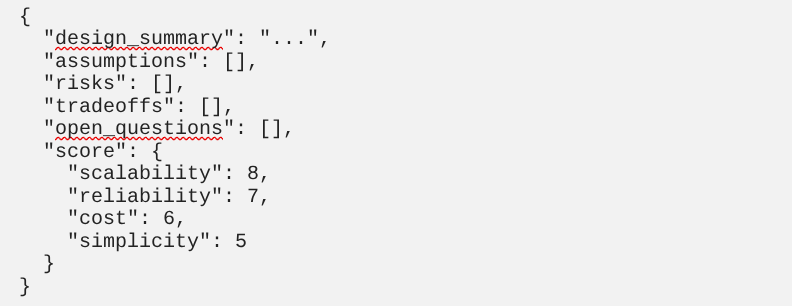
Once the workflow is structured, it becomes repeatable.
The Final Output
The goal is not a long AI-generated essay.
The goal is a useful engineering artifact:
- Final recommended design
- Rejected alternatives
- Architecture diagram description
- Service boundaries
- Data ownership
- API contracts
- Event flows
- Failure scenarios
- Observability plan
- Security review
- Rollout strategy
- Open risks
This is exactly the kind of output an engineering team can take into a real design review.
Why This is Better Than Manual Prompting
Manual prompting depends on the skill and patience of the engineer.
Agentic design review makes the process repeatable.
Every design is challenged. Every tradeoff is scored. Every risk is documented. Every final recommendation has a reasoning trail.
That is the real advantage.
Not: AI gives us architecture.
But: AI helps us run a faster, stricter, more consistent architecture review before humans make the final decision.
The Future: CI for Architecture
The next step is obvious.
Architecture reviews can become part of the software life cycle.
A team could submit a design brief, and the agentic workflow could automatically generate:
- First-pass architecture
- Risk review
- Cost analysis
- Security concerns
- Implementation plan
- ADR
- Reviewer checklist
Eventually, this can connect to code repositories, existing service catalogs, observability data, cloud cost dashboards and incident history.
At that point, system design becomes less of a blank-page exercise and more like continuous architecture validation.
Final Thought
The future of AI-assisted system design is not one model giving one confident answer.
It is a group of specialized agents debating, disagreeing, repairing, scoring and converging.
The human architect still makes the final decision.
But now, before that decision is made, every design has already survived a machine-speed architecture review.
That is the real promise of agentic system design.