Harness today is providing DevOps teams with an ability to build and deploy autonomous artificial intelligence (AI) agents that automate the delivery of code to production environments.
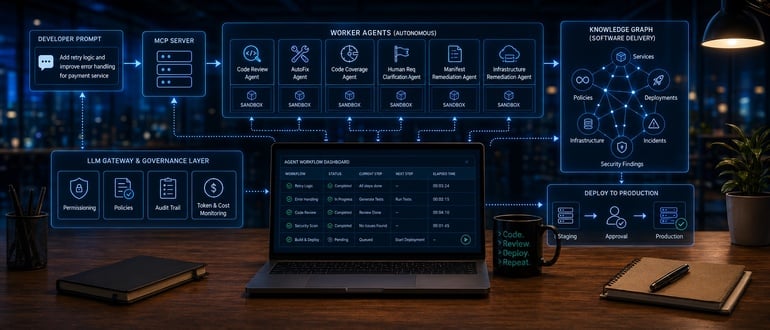
Trevor Stuart, a senior vice president and general manager at Harness, said the Autonomous Worker Agents eliminate the need for fixed scripts with custom AI agents or ones provided by Harness that run in a sandbox container environment.
Via the Harness Model Context Protocol (MCP) Server, a developer using an AI coding tool can assign a task to a Worker Agent, with the result returned to wherever it was triggered. Each agent has its own identity and a specific set of permissions assigned to it to ensure it only executes tasks allowed, no matter who triggers it or what its prompt says.
Once triggered, the agent invokes the Harness Software Delivery Knowledge Graph, a connected map of your services, pipelines, deployments, infrastructure, incidents, and security findings, to understand the unique context of a DevOps workflow. Autonomous Worker Agents work with multiple providers of AI models to make it possible to switch models per agent, per environment, or per pipeline without rewriting the agent.
Each AI agent is also centrally managed via a large language model (LLM) Gateway that applies the same governance policies used for human software engineers with audit trails spanning multi-agent workflows created that enable DevOps teams to employ them in highly regulated environments, he added.
Token consumption and spending are surfaced per agent and per pipeline to enable DevOps teams to keep control over costs.
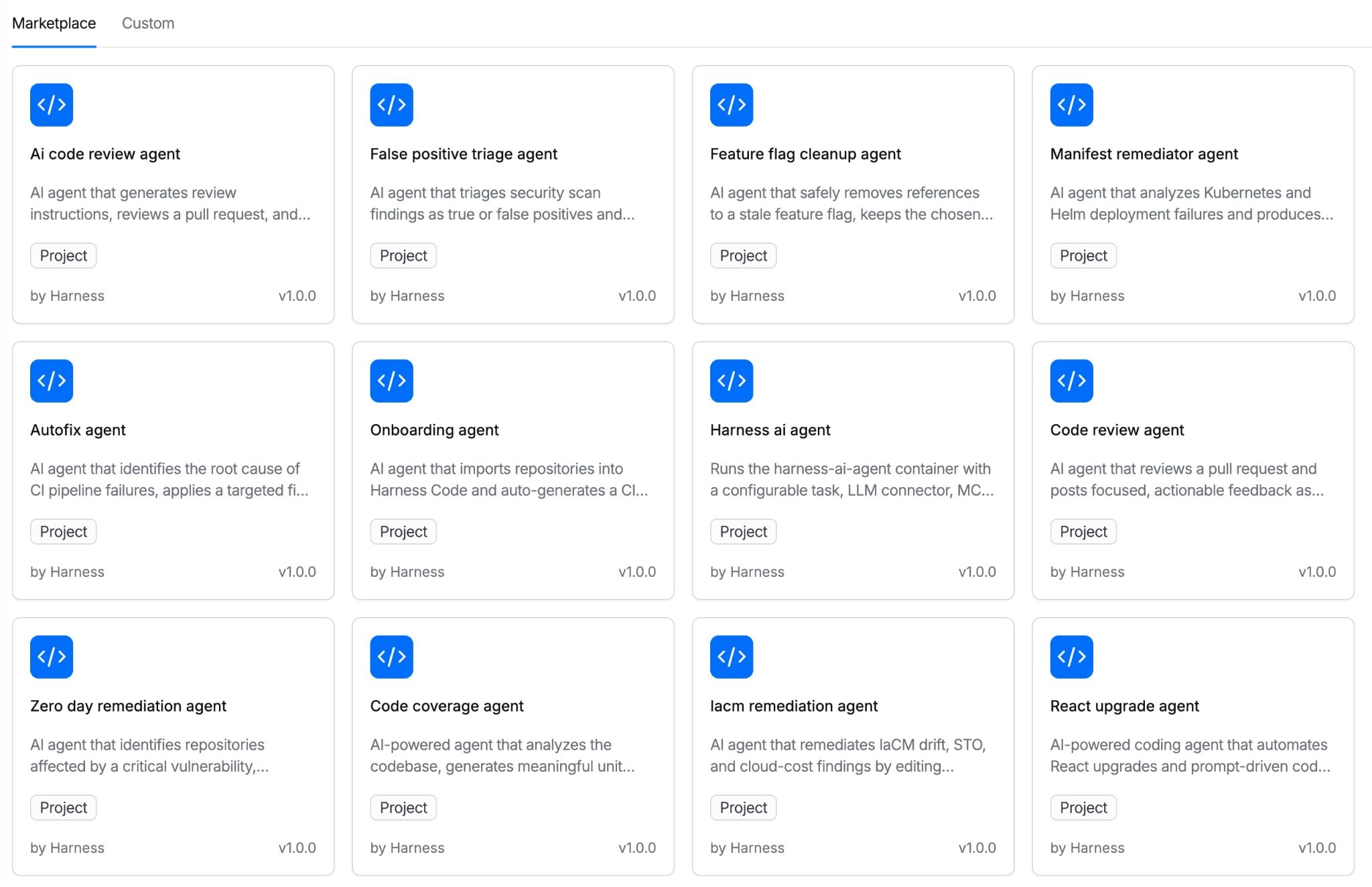
Harness is now making AI agents it has built available via a Harness Agent Marketplace. They include an Autofix agent that reads logs, identifies the root cause of a build failure, commits a fix to the pull request (PR) branch and re-triggers builds until it passes and a Code Review agent that reviews PRs for code quality, security issues, and test coverage.
There is also a Code Coverage agent that identifies untested lines and generates tests to close coverage gaps, a Feature Flag Cleanup agent that detects stale flags and validates safe removal, a Manifest Remediator agent that analyzes failed Kubernetes deployments and fixes manifest issues, and an IaCM Remediation agent that fixes configuration drift, security findings, and cloud cost issues by editing infrastructure configurations.
Additionally, Harness is allowing every agent in the Marketplace to be forked. DevOps teams can create their own agent by cloning an existing agent and adjusting the prompt, tools, or triggers to fit their environment.
The overall goal is to make it simpler to coordinate the activities of AI agents across multiple asymmetrical workflows spanning the entire software development lifecycle (SDLC), said Stuart. Each software engineer going forward will, for all intents and purpose, function more like a software architect, he added.
Naturally, each DevOps team will need to determine their level of comfort with relying on AI agents to automate tasks, but the thing that is certain is that over time the need to build, maintain and update scripts is becoming increasingly obsolete with each passing day.