

The emergence of AI has brought endless possibilities and innovative opportunities in today’s ever-changing, fast-paced technology landscape. AI is helping development teams produce software significantly faster than ever before.
AI-enabled DevSecOps tools can automatically scan code, infrastructure and other configurations for security issues throughout development, accelerating the overall process.
The introduction of agentic AI into the software development life cycle (SDLC) ensures less time and effort are spent on risk assessments and that incidents can be remediated far more quickly than with traditional methods.
The Need for an Agentic Layer in DevSecOps
Presently, many organizations use AI as part of the DevSecOps process to automate security tasks and improve efficiency in delivering and integrating code before deployment. Most organizations have access to multiple security tools; however, these tools do not work together to provide a comprehensive solution for the organization’s overall security posture, creating potential gaps and vulnerabilities.
Agentic AI automates security testing across the entire DevSecOps pipeline and enhances your ability to detect and remediate vulnerabilities throughout the SDLC. Agentic AI also allows you to have an ongoing understanding of your security posture throughout the entire software development process. It provides autonomous agents that can help you secure, optimize and manage your DevSecOps pipelines.
The DevSecOps process has always included security throughout the development life cycle, so by integrating an agentic layer into the software, the person or team developing can continuously access security guidance and assessments throughout the process, rather than waiting until the end of the development cycle.
While it is advantageous for an agentic security co-pilot to monitor events occurring in an automated delivery pipeline, an agentic security co-pilot must also have access to and the ability to analyze data from multiple input sources (event logs, code repositories, etc.) to make recommendations or trigger precursory actions in accordance with corporate policy and business rules.
Thus, agentic security co-pilots should possess both limited decision-making authority and the capacity to operate autonomously under a predefined set of corporate policies and business rules.
Agentic AI vs. Traditional Automation Approaches
Agentic AI comprises a collection of autonomous, decision-making AI agents capable of proactively managing and optimizing development, security and operations tasks.
Additionally, these AI agents continuously learn, adapt and take action within your continuous integration/continuous delivery (CI/CD) pipeline to secure your code, improve its quality and accelerate software delivery.
Agentic AI uses autonomous AI agents to optimize, manage and secure DevOps and security pipelines.
Unlike traditional DevOps, wherein security is embedded into the SDLC, agentic AI provides an additional layer of intelligence, helping facilitate decision-making and coordinate activities across teams and tools, rather than relying on manual security-embedding.
Agentic AI also allows DevSecOps to evolve from a rule-based automated process to an intelligent, orchestrated process. An added benefit of agentic AI is its ability to continuously monitor and analyze log files, network traffic and runtime activity. Agentic AI provides proactive security testing when developing software, as opposed to traditional methods of automating security testing that react to security vulnerability exploits after they happen.
Traditional automation runs security tests on the software after it has been developed and is ready to be shipped. Agentic AI enables the creation of security tests for software based on context and provides real-time incident response.
Steps for Integrating Agentic AI Into DevSecOps
Agentic AI searches your source code, configuration data and infrastructure to detect potential security risks and vulnerabilities in real-time, providing meaningful, valuable insights. Successful integration of agentic AI into DevSecOps depends on establishing a process that includes the following steps:
Step 1: Analyze Existing Security Practices
You should first analyze your existing development and security processes and see where you can improve. Using results from the analysis of current security practices can help you develop AI-enabled solutions that will meet your specific development needs.
Step 2: Integrate AI Tools Into DevOps Pipelines
Next, you should add agentic AI to your DevSecOps pipeline to enable automated security testing, vulnerability scanning and threat monitoring. With AI incorporated into your DevSecOps pipeline, you can quickly identify and mitigate security vulnerabilities and threats in real-time without affecting your development projects.
Step 3: Automate Threat Detection
In the next step, use agentic AI to continuously scan and assess your software, configurations and infrastructure for potential vulnerabilities. Additionally, you can set up notifications to alert your DevOps teams so they can take action proactively and mitigate identified risks before they become more severe.
Step 4: Continuously Monitor
Now that you’ve automated threat detection, the next step is to incorporate agentic AI’s real-time threat intelligence capabilities to remain aware of the security threats continually affecting your IT environment. The agentic AI system can provide automatic remediation recommendations to eliminate existing threats or notify your security responder team of the incident.
Step 5: Educate and Train
Finally, you should train and educate your development and security teams to understand how to effectively integrate AI into their respective workflows. With this knowledge, teams can better leverage agentic AI capabilities to achieve optimal results when securing their development environments.
Agentic AI Integration Into DevSecOps: An Architectural Overview
Typically, six stages flow vertically through your entire software development pipeline.
- Plan and Code: The team creates and documents what to code.
- Build and Test: The code is compiled and then run through tests to ensure there are no defects.
- Package: The compiled code or built artifact is prepared for release.
- Deploy: The package is deployed to a specific environment.
- Monitor: The application is monitored for potential runtime issues.
- Loop: In this stage (indicated by dashed arrows), feedback from monitoring is sent to the plan and code stage, forming a complete loop.
Figure 1 illustrates a typical DevSecOps pipeline integrated with agentic AI and how agentic AI intercepts the workflow at various stages.
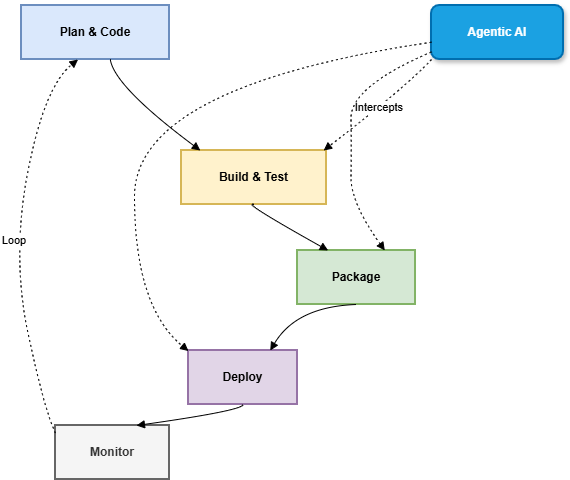
Figure 1: A Typical DevSecOps Pipeline Integrated With Agentic AI Security
There are three main checkpoints where the agentic AI intercepts your DevSecOps pipeline:
- During the build and test stage, before finalizing the build, the agentic AI can inspect for potential security vulnerabilities, code quality and policy violations.
- During the package stage, before storing or releasing an artifact, the agentic AI can alert teams about any issues with the artifact that will be produced.
- During deployment, the agentic AI approves or disapproves an application’s production-readiness.
Takeaways
- As applications become more complex and diverse, there will be a greater need for continuous monitoring and improvement in the SDLC.
- Agentic AI can help improve DevSecOps by enabling real-time threat detection, autonomous security testing and intelligent pipeline management using an AI-first approach.
- Agentic AI is made for DevSecOps and uses autonomous AI agents to optimize, manage and secure the DevOps and security pipelines.
- Agentic AI also provides proactive security testing, as opposed to traditional methods of automating security testing that react to security vulnerability exploits after they happen.
- Most organizations have too many security tools at their disposal, but they are often not connected to each other, creating security gaps and vulnerabilities.
- Today, organizations are using AI to automate DevSecOps processes, enabling quicker, less resource-intensive integration, testing, deployment and monitoring of software.
- Although you can leverage AI to continue developing software at an incredibly quick pace, you now need to be more aware of the security implications and ensure they don’t negatively impact software delivery.