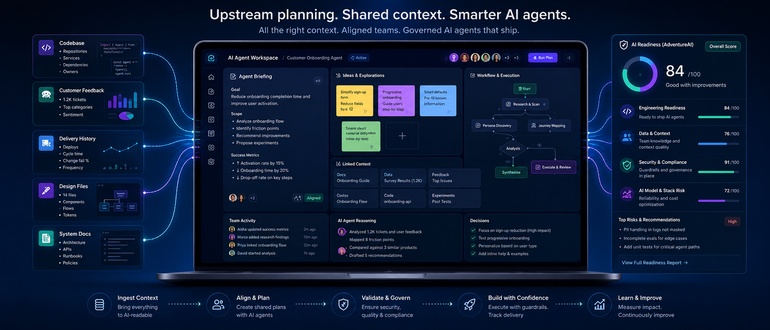
Allstacks this week added a shared workspace capability to its software engineering intelligence platform that makes it simpler for product and software engineering teams to create specifications for artificial intelligence (AI) agents that organizations plan to develop and deploy.
Product Studio provides teams with a place to plan, draft, and refine product requirements using the context that already exists in a software-as-a-service (SaaS) application platform that is used to track the relationship between codebases, customer feedback, delivery history, design files, and strategy documents.
Additionally, Allstacks has included an adversarial AI reviewer tool that scores every specification against engineering feasibility, team capacity, security, and historical rework rates before a project is launched.
Allstacks CEO Hersh Tapadia said Product Studio enables teams to design AI agents much further upstream. That’s critical because it’s not really feasible to iteratively develop AI agents that once deployed are performing autonomous tasks at machine speed, he added.
The specifications that teams collaboratively define for AI agents are now the most crucial phase of software development, said Tapadia. Weak specifications result in weak code that leads to rework, production instability, and higher costs downstream, he noted.
That latter issue is becoming especially problematic because the AI coding tools used to create AI agents have limited access to memory. The more information about the application environment the less memory there is to reason about the actual development of the AI agent. DevOps teams instead can expose AI coding tools to Product Studio to provide the context required, which eliminates the need to reload that data every time an AI coding tool is used to build an AI agent.
In effect, Product Studio provides AI coding tools with the institutional context needed to provide a harness that can be relied on to build AI agents more efficiently, said Tapadia.
It’s not clear to what degree the rise of AI might drive more organizations to adopt a software engineering intelligence platform, but as application development evolves in the age of AI the line between software engineering and product development continues to blur.
Mitch Ashley, vice president and practice lead for software lifecycle engineering at the Futurum Group, said there is a clear need to re-engineer how specifications are created, evolve, and are integrated in the era of AI-native development. When agents plan, orchestrate, generate, and act at machine speed, the emphasis moves to intent, he added.
For example, what did the original prompts mean to add in the broader context, and did the direction the agents receive adequately communicate it, noted Ashley. Teams that leave verification at the code and pull-request stage will absorb rework debt at agent scale so the obligation now is to instrument feasibility, capacity, and security checks at specification time before a weak one leads to weak code being deployed, he added.
Ultimately, it’s not so much a question of whether DevOps teams now need software engineering intelligence so much as it is how much is enough in the AI era.