If you’re already familiar with sandboxing as an isolation technique, sandbox security is the next layer: the policies, controls, and enforcement mechanisms that make sure those isolation boundaries actually hold under real-world pressure.
According to our State of Agentic AI report, 40% of respondents cite security as the top challenge in scaling agentic AI, and 43% point to increased security exposure from orchestration sprawl. As agents execute code, call APIs, and interact with live infrastructure, a sandbox without strong enforcement is a locked room with an open window.
This piece goes deeper into what sandbox security looks like day to day. We’ll cover how to choose the right implementation model and why this layer of security matters now more than ever as AI agents start executing code in your infrastructure.
Key takeaways
- Sandbox security is the practice of enforcing isolation boundaries and access controls around sandboxed environments to prevent threats from escaping containment.
- Effective sandbox security combines multiple layers: process isolation, network segmentation, resource limits, and runtime monitoring.
- As AI agents increasingly execute arbitrary code in production, sandbox security has become critical infrastructure for safe deployment.
What sandbox security means in practice
Sandbox security is the set of controls and enforcement mechanisms that prevent untrusted or risky processes from breaching their isolation boundaries. Where sandboxing creates the boundary, sandbox security ensures it holds.
As we mentioned before, a sandbox without strong security controls is like a locked room with an open window. The isolation exists in theory, but the enforcement gaps leave room for escape.
For developers and platform engineers, this translates into concrete, daily decisions: which system calls an agent is allowed to make, whether a process can reach the network, how much memory or CPU it can consume, and what happens when it tries to exceed those limits. These are not abstract policy questions. They’re flags you set, profiles you configure, and defaults you either audit or accept on faith.
5 Core components of sandbox security
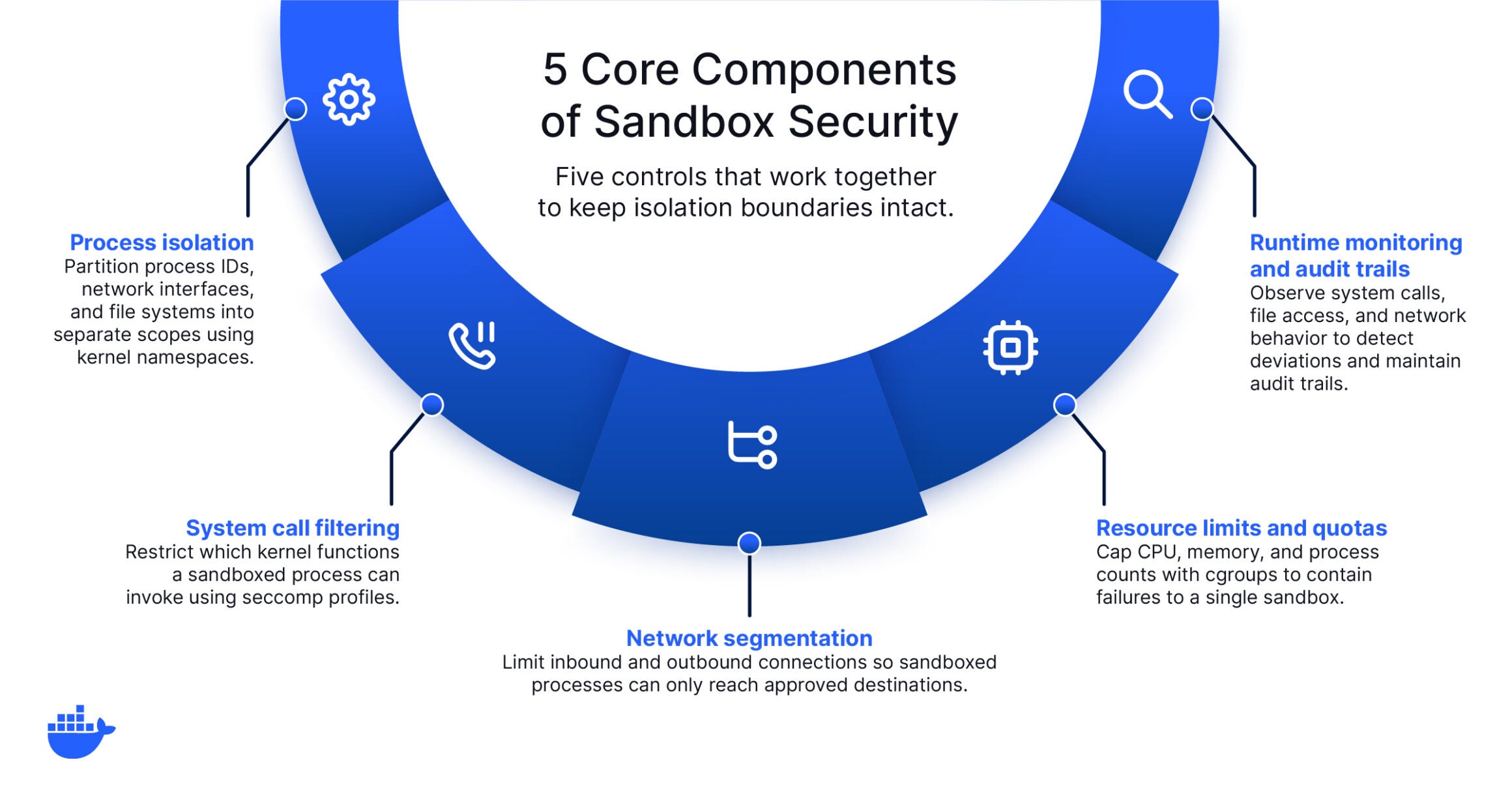
Sandbox security is not a single control. It’s a combination of mechanisms that work together to keep isolation boundaries intact. The most effective implementations layer several of these components so that a failure in one area does not compromise the entire sandbox.
1. Process isolation
Process isolation ensures that code running inside a sandbox has no visibility into processes on the host or in other sandboxes. On Linux, kernel namespaces handle this by partitioning process IDs, network interfaces, file systems, and user IDs into separate scopes. A process inside a namespace sees only what you’ve explicitly made available to it.
When things go wrong. Run a container with –pid=host and you’ve just given that workload a window into every process on the machine. It can enumerate services, identify targets, and attempt to interfere with them. That single flag turns your sandbox into a shared apartment.
Proper sandbox security eliminates this by enforcing strict namespace boundaries by default and flagging configurations that weaken them.
2. System call filtering
Even within a namespace, processes interact with the host kernel through system calls. System call filtering (commonly implemented through seccomp profiles on Linux) restricts which kernel functions a sandboxed process can invoke. Docker’s default seccomp profile blocks around 44 of the 300+ available Linux system calls. That’s a meaningful reduction in attack surface, but it’s a general-purpose default, not a tailored fit.
What to look for. High-security workloads benefit from custom seccomp profiles scoped to the specific application. A sandboxed process that needs to read files and make HTTP requests has no reason to call mount, init_module, or reboot. The tighter the profile, the fewer options an attacker has if they gain code execution inside the sandbox. It’s the same least-privilege thinking that underpins container security more broadly.
3. Network segmentation
A sandbox that can communicate freely with external systems or internal services is harder to defend. Network segmentation restricts what a sandboxed process can reach, limiting both inbound and outbound connections. That’s especially important for workloads that process untrusted input or execute arbitrary code.
How this applies to agents. AI agents that invoke external tools or APIs during execution present a unique challenge. Without network controls, a compromised agent could exfiltrate data to an external endpoint or pivot to internal services it was never intended to reach. Enforcing egress policies at the sandbox environment level ensures agents can only communicate with pre-approved destinations.
4. Resource limits and quotas
Resource exhaustion attacks do not require a sandbox escape, and that’s what makes them easy to overlook. A runaway process that consumes all available CPU or memory can take down every other workload on the same host without ever breaching an isolation boundary. Cgroups on Linux cap what each sandbox can consume, turning a potential host-wide outage into a single contained failure.
The tricky part is calibration. Set memory limits too low and legitimate workloads get OOM-killed. Set them too high and you’re back to sharing the blast radius. The most reliable approach is to monitor actual resource consumption over time, set limits based on observed peaks plus a margin, and treat the initial configuration as something you’ll tune rather than something you’ll get right on the first pass.
5. Runtime monitoring and audit trails
Prevention is only part of the equation. You also need to know what’s happening inside the sandbox. Runtime monitoring tools observe system calls, file access patterns, network connections, and process behavior as they occur. When something deviates from the expected baseline, the system can alert operators or kill the process automatically. If you’re evaluating AI governance tools, you’ll find that many of these runtime observability capabilities overlap directly with agent monitoring requirements.
Audit trails serve a different but equally important purpose. When an incident does happen, you need a forensic record of exactly what the sandboxed process did: which files it touched, which endpoints it called, which syscalls it made. That’s valuable for incident response and essential for compliance frameworks that require demonstrable evidence of isolation and access control.
Choosing an implementation model
Understanding the different sandboxing models is a good starting point, but the more useful question for sandbox security is: what does each model actually protect against, and what do you need to configure to make it hold? Here’s how they compare on the dimensions that matter for security decisions.
|
Model |
Isolation boundary |
Key security controls |
Best for |
Watch out for |
|
OS-level namespaces, seccomp, MAC |
Shared kernel, separate namespaces |
seccomp profiles, AppArmor/ SELinux policies, read-only rootfs, capability dropping |
Container runtimes, CI/CD jobs, most production workloads |
Kernel vulnerabilities bypass all controls; defaults are permissive |
|
VM-based microVMs, hardware virtualization |
Separate kernel per sandbox |
Hypervisor-enforced memory isolation, independent kernel patching, vTPM |
Multi-tenant platforms, malware analysis, running fully untrusted code |
Higher resource cost; networking and image management add ops complexity |
|
Application-level Wasm, browser tabs, language VMs |
Within-process memory and API restrictions |
Memory-safe execution model, restricted host API surface, capability-based permissions |
Plugin systems, edge functions, embedded scripting |
App compromise bypasses internal sandbox; should never be the only layer |
The right choice depends on your threat model. For most containerized workloads, OS-level controls with a hardened seccomp profile and mandatory access control policy provide strong security at minimal overhead. VM-based isolation makes sense when you genuinely do not trust the code being executed, such as in multi-tenant environments or agent-driven code generation. Application-level sandboxing is a valuable addition in either case, but it should layer on top of kernel-level or hypervisor-level controls, never replace them.
Whichever model you choose, treat the default configuration as a starting point. The security of any sandbox does depend on the isolation technology, but whether someone actually audited the settings is the sticking point. It’s the same software supply chain security discipline that applies at every layer of the stack: trust, but verify the configuration.
Sandbox security for AI agents
Traditional applications follow predictable execution paths. You can read the code, trace the logic, and anticipate the behavior. AI agents are a different story. They make decisions at runtime, generate and execute code on the fly, call external tools, and produce outputs that their own developers may not have anticipated. That autonomy is the whole point of agents, but it’s also what makes sandbox security non-negotiable.
In these situations, perimeter-based security is not sufficient. You need controls that constrain agent behavior at the execution level, regardless of what the agent decides to do. It’s a fundamentally different security challenge. Teams building AI agent sandboxes are converging on a few patterns that address the unique risks agents introduce.
Isolating tool use
When an AI agent invokes a tool (a code interpreter, a file manager, an API client), each tool execution should run inside its own sandbox with the minimum permissions required. If the agent’s tool-use layer is compromised, sandbox security prevents that compromise from reaching the host or other services.
Controlling data access
Agents often process sensitive data as part of their reasoning. Sandbox security controls which files, databases, and environment variables are visible inside the agent’s execution environment. A well-configured secure sandbox exposes only the data the agent needs for its current task, nothing more.
Enforcing network boundaries
Left unchecked, an agent with network access could make arbitrary HTTP requests, potentially exfiltrating data or interacting with unintended services. Network-level sandbox security restricts egress to an allowlist of approved endpoints.
Getting started with sandbox security
Start with your threat model. Which workloads process untrusted input? Which ones execute arbitrary code or handle sensitive data? Those are your highest-priority candidates for hardened sandbox security.
From there, layer controls rather than relying on any single mechanism. Combine process isolation with system call filtering, add network segmentation, set resource limits, and enable runtime monitoring. Each layer addresses a different category of risk. Together, they create a posture where any single failure stays contained.
If you’re already running containers, much of the foundation is in place. Container runtimes provide namespace isolation, seccomp profiles, and cgroup limits out of the box. The next step is to actually audit those defaults against your requirements and tighten what needs tightening. Docker Sandboxes extend this with purpose-built microVM isolation for agent workloads.
Start with Docker Sandboxes to put sandbox security into practice.
Frequently asked questions
What is the difference between sandboxing and sandbox security?
Sandboxing is the technique of running code in an isolated environment. Sandbox security is the broader discipline of ensuring that isolation actually holds. It’s the policies, configurations, monitoring, and enforcement mechanisms that make a sandbox resistant to escape, resource abuse, and unauthorized access. You can have a sandbox without strong security, but the isolation it provides will be unreliable.
Can sandbox security prevent all container escapes?
No single security measure can guarantee complete protection. Sandbox security significantly raises the bar by layering multiple controls (namespaces, seccomp, network policies, resource limits, runtime monitoring) so that an attacker would need to bypass several independent defenses. This defense-in-depth approach reduces risk to a level most organizations consider acceptable, especially when combined with regular patching and configuration audits.
How does sandbox security affect application performance?
The performance impact varies by implementation. OS-level controls like namespaces and seccomp add negligible overhead. Network policies and resource limits introduce minimal latency. VM-based sandbox security has higher overhead due to hardware virtualization, but technologies like microVMs have narrowed that gap significantly. For most workloads, it’s a trade-off that strongly favors security.
Is sandbox security relevant for AI and machine learning workloads?
Absolutely. AI workloads, particularly agents that execute code dynamically, are among the highest-priority use cases for sandbox security. These workloads are inherently unpredictable, and that’s exactly why strong isolation boundaries are essential. Sandbox security ensures that even if an agent produces unexpected behavior, the impact stays contained within its execution environment.
What compliance frameworks require sandbox security?
Several frameworks reference isolation and access controls that map directly to sandbox security practices. SOC 2 requires logical access controls and monitoring. PCI DSS mandates network segmentation for systems handling payment data. FedRAMP and NIST 800-53 include specific controls around process isolation and boundary protection. Organizations pursuing these certifications often find that container-based sandbox security, guided by a structured AI governance framework, provides a strong implementation foundation.